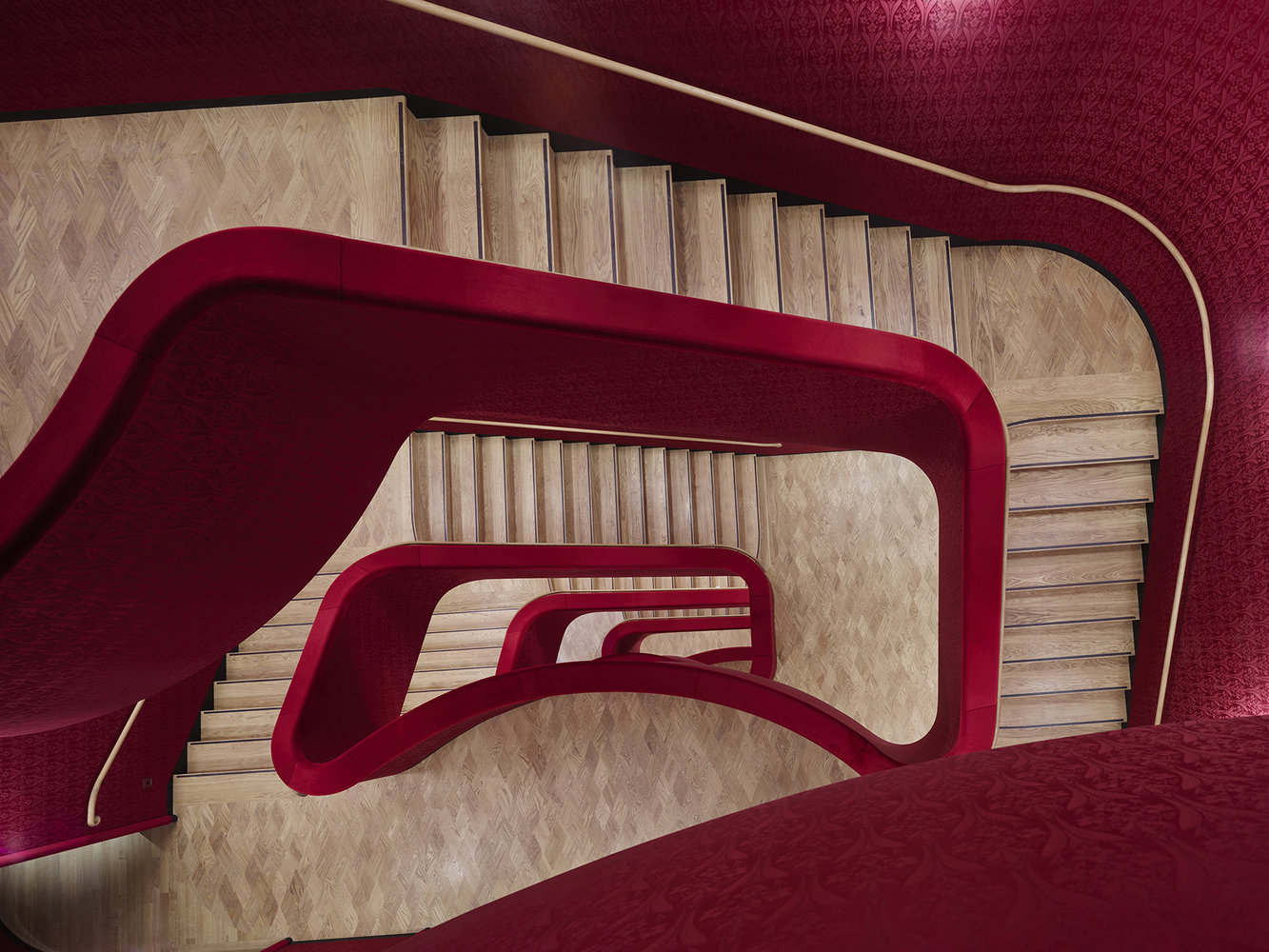
An exhibition worth seeing traces Ligeti's work in nine striking modules.
Verena Naegele
(translation: AI)
- Dec 12, 2023
The original documents are mounted on grids. Photos: Philipp Emmel/Historisches Museum Basel, Musikmuseum
The Ligeti year is almost over and the 100th birthday of the Hungarian composer, who died in 2006, has been commemorated in detail in newspapers, events and radio reports. So it may seem like "snail mail" to some that the Paul Sacher Foundation is only now presenting an exhibition: In the Music Museum of the Basel Historical Museum the majority of the objects on display are from György Ligeti's estate held in the Foundation.
This "late" honor is mainly due to timing. The Budapest Music History Museum - one of the cooperation partners is the Musicology Institute of the Budapest Research Center for the Humanities Hun-Ren - where the exhibition was previously on display, only had capacity for it in spring 2023, while the Basel premises were only available from November. These circumstances do not detract from the content of the exhibition, which is highly recommended and can be seen until April 7, 2024.
It not only demonstrates Ligeti's high status in 20th century music, which continues unabated, it also introduces us to the composer's thinking and work in a fascinating way that will probably not be possible again so soon. An essential part of this "journey" into the "Ligeti labyrinth", as the exhibition is called, are the many originals to be admired - a quality that is unfortunately being increasingly neglected.
Maze in prison cells
However, anyone expecting a chronological presentation will be disappointed - fortunately. Instead, the focus is on the various facets of Ligeti's thinking, creativity and working processes, which are explored in nine modules. Topics such as "Dreams and Fantasies" or the "Web of Voices" immediately catapult connoisseurs of Ligeti's works into his special world.
The striking modules were devised by Heidy Zimmermann from the Sacher Foundation, which has been looking after the Ligeti estate for years, and the Hungarian musicologists Anna Dalos and Márton Kerékfy. The concept and idea are based on a statement by Ligeti: "I feel my way forward from work to work, in different directions, like a blind man in a labyrinth." And this "Ligeti labyrinth" finds a fascinating counterpart in the Lohnhof Basel music museum with its former prison cells, which is difficult to play.
On display is a wide range of source material that has been carefully selected and annotated. According to estimates by Heidy Zimmermann, the Ligeti estate comprises around 25,000 pages of manuscript, 10,000 pages of correspondence and 800 photos, films and audio documents. Without knowing what else is hidden in this treasure trove, the selection presented in Basel seems stringent and exciting. In this way, Ligeti's personal working process can be studied in a unique way.
Graphic concepts for musical factors
For each of his works, Ligeti wrote down pages and pages of conceptual ideas, not notes but words, wildly jumbled together with various colored pencils or sometimes in graphic representations. What at first glance appears to be an impenetrable jumble becomes an eye-opening experience in the vicinity of the composed work. The accompanying texts provide the necessary background and the music excerpts shown can also be listened to on a cell phone.
For example, there is a sketch of the famous Atmosphères (1961), on which the music is precisely described with the disposition of the form parts and their precise duration. Or there is a sketch of the course of Aventures (1962), which records the vocal and instrumental parts on four A4 sheets glued together horizontally, as a "time and form control", as is noted on it. Why did Ligeti first make such extra-musical sketches? "Ligeti only received piano lessons at the age of 14," explains Heidy Zimmermann, "so he had to imagine musical impressions for a long time because he had no way of writing them. Perhaps that is the reason for this path."
Ligeti's special path is illustrated by the Violin Concerto (1990-1992), which is discussed in the chapter "Mood and detuning". There are no fewer than five sheets of colorful verbal sketches. Kerékfy characterizes these in the excellent accompanying catalog: "The notes refer partly to the form of the movements, partly to their melodic content and metrical structure. Ligeti also planned the basic tempo and the estimated duration."
Another module focuses on the "Rhythmic Discoveries". It shows Ligeti's turn to polyrhythms, as used in the Piano Concerto (1985), for example. He was inspired by the music of a Central African tribe, the Banda Linda, which consists of rhythmic polyphonic patterns. Ligeti owned a collection of around 140 records with traditional folk music from all over the world, which is presented in a themed room with all the covers. This is an exciting aspect that also stimulates discussion in the case of Ligeti. There is so much to see and read in Basel.
A cell shows covers from Ligeti's record collection. Photo: Philipp Emmel/Historisches Museum Basel, Musikmuseum
The third installment of Sonic Matter, the festival for experimental music in Zurich, was held under the motto "Leap". Over 4 days, 16 events were offered at several concert venues and in different formats.
Thomas Schacher
(translation: AI)
- 11 Dec 2023
Opening concert in the Schiffbau: Mazen Kerbaj's pictures are projected onto the screen. Photo: Kira Kynd
The good news right at the start: Sonic Matter can be continued. At the request of Zurich City Council, the municipal council has decided to continue supporting the festival for experimental music over the next four years with an annual operating grant of CHF 250,000. The City of Zurich is the main sponsor of Sonic Matter. The festival, which emerged from the Tage für Neue Musik Zürich in 2021, was previously in a pilot phase and had its creditworthiness assessed by an external company.
Getting to know something different
After the first edition with the motto "Turn" focused on musical and extra-musical changes and last year's "Rise" was intended to understand standing up in a political sense, the motto "Leap" now formed the bracket for the third year. In the foreword to the program, the two artistic directors Katharina Rosenberger and Lisa Nolte invited the audience to "take a leap into the unknown together". The interconnectedness of the world should be used as an opportunity to get to know what is different, to embrace the unforeseen. In addition to musicians from Switzerland, numerous foreign artists, primarily from the Middle East, were also invited. And as a guest, the Festival Irtijal Beirut is also part of the party.
Surprising sounds and twists
The opening concert in the Schiffbau of the Schauspielhaus Zurich provided a concrete expression of these ideas. The encounter with the Iranian composer and qanun player Nilufar Habibian was exciting. In her piece Becoming the oriental zither forms astonishing combinations with the electric guitar, cello and bass clarinet. Guitarist Sharif Sehnaoui and video artist Mazen Kerbaj, the two founders of the Beirut festival Irtijal, provided a powerful contrast to this performance by the Geneva-based ensemble Contrechamps with their impromptu performance Wormholes. To the unusual sounds of the prepared guitar, Kerbaj drew and sprayed abstract images on a foil, which were simultaneously projected onto a screen. In the light of the current war in Gaza, the suddenly appearing sentence "We are the dead of tomorrow" read as a clear political message. The composition for live ambisonic turntables and immersive electronics presented at the end by the composer Shiva Feshareki offered surprising 360-degree sound experiences, but clearly took too long compared to the wealth of ideas.
The traditional Tonhalle concert, which Sonic Matter announced at short notice would not take place as part of the festival this time, was accompanied by a scandal. Both organizers remained silent about the reasons. When asked, Sonic Matter's press spokesperson merely stated that the decision was "due to the geopolitical situation". In any case, the decision to cancel the Tonhalle concert meant a loss of prestige for Sonic Matter.
Outdoor sound course. Photo: Kira Kynd
Lounge, Party, Course, Marathon
In addition to the traditional concerts, Sonic Matter once again offered alternative presentation formats, such as the Listening Lounge with current electro-acoustic music from twenty countries, the party for young people with the DJ group Frequent Defect from the Beirut club scene and an outdoor sound trail. The four-hour concert marathon Long Night of Interferences at the Theaterhaus Gessnerallee allowed music from different cultures to collide. The Swiss part of this was provided by the world premiere of a new work by Geneva composer Denis Rollet, in which violin, bass clarinet and live electronics go through various stages of convergence and distance.
"Umva!" by Aurélie Nyirabikali Lierman with the group Silbersee at the final concert in the Rote Fabrik. Photo: Kira Kynd
The festival took a major geographical and aesthetic leap with the closing event at the Rote Fabrik. The composer, who lives in the Netherlands Aurélie Nyirabikali Lierman and her group Silbersee whisked the audience away in their performative installation Umva! to Rwanda. The subject is the life of Aurélie's grandfather Kanyoni Ladislas, who lived in Rwanda as a cowherd and natural healer and died at the age of 113. The narrative, the dance elements and the playing of traditional African instruments and the "European" violin created a fascinating Afro-European musical theater.
Conclusion after three years
After the third edition of Sonic Matter, it is clear that the festival has become an integral part of the avant-garde music scene that people no longer want to miss. However, the variety of presentation forms, the aesthetic breadth of the performances and the participation of artists from half the world also harbors the danger of a certain arbitrariness and also leads to a division of the audience into different interest groups.
Listening Lounge with current electro-acoustic music from twenty countries. Photo: Kira Kynd
Liechtenstein Music Academy focuses on holistic human development
The Liechtenstein Academy of Music has had a new look since yesterday. It presented it on the construction site: the "Hofstätte Hagenhaus" campus, including the concert hall in Nendeln, is expected to be ready for occupation next fall.
SMZ/ks
(translation: AI)
- 01 Dec 2023
The highest governing body of the Liechtenstein Academy of Music is the Foundation Board. Pictured at the press conference on November 30 in the concert hall are, from left to right: Jürg Kesselring, Drazen Domjanic (Artistic Director), Otmar Hasler (President), Olav Behrens (Vice President), Christina Zeller and, at the top of the screen, cellist Kian Soltani, alumnus and now professor at the Music Academy Liechtenstein. Photo: SMZ
The floor is still raw concrete, the access door a temporary solution. Nevertheless, the press conference took place in the future concert hall of the Liechtenstein Music Academy, which was founded in 2010 and is headed by Drazen Domjanic. The hall is located in the former Tenn of the Hagenhaus estate in Nendeln. The buildings there are currently being renovated and supplemented by a new building. The music academy is expected to find a new home with promising development opportunities there from next fall.
In the course of this major change, the appearance was completely revised, as was the training concept. The Music Academy aspires to be "a leading institution in the international music world with firm roots in the Principality of Liechtenstein". It sees its educational program as a complement to the Bachelor's and Master's programs at music universities. In addition to the proven high-quality musical education of young, exceptionally talented musicians from all over the world by internationally outstanding teachers, the focus is on the holistic education of the individual. This includes comprehensive career planning that promotes people with all their social, health and economic needs. The three courses appeal to different age groups: Students up to the age of 18, those over 18 and those who already have a Bachelor's degree. A large part of the training is financed by scholarships.
For my article "Mystery in the shower" (Schweizer Musikzeitung 12/2023), I interviewed musicians. Their detailed answers can be read here in alphabetical order.
Hanspeter Künzler (translation AI)
(translation: AI)
- Nov 29, 2023
Strolling along whistling: Niklaus Keller in Bologna. Photo: zVg
Annakin, Singer/Songwriter
What does "inspiration" mean to you?
For me, inspiration is the state of mind it takes to write a good song. It is the epiphany, a revelation or a flash of inspiration, the shot of endorphins and the start of something exciting. It's at the beginning and is important for the creative process to flow.
Does it take "inspiration" to create or is hard work enough?
I can't really do without inspiration, because without it you can hardly make any progress, if at all. And I also believe that you can hear it in a song because it then sounds uninspired. Inspiration is therefore an indispensable source for me to be able to work creatively and perhaps also a seal of quality. I don't think the result is the same if you work hard on something creative in an uninspired way. Because, in my opinion, inspiration animates the work.
What circumstances are most likely to lead to creative inspiration for you?
At some point I realized that there are methods for tapping into inspiration. For example, I often just write down my inner monologue in search of good lyrics. Sooner or later, my thoughts circle around something that is worth pursuing or a play on words arises that I record. Basically, you can find inspiration everywhere if you sharpen your senses. Just recently, I couldn't quite read a sign that said "Brockenhaus" from a distance and thought it said "Broken Hans". A wonderful title for a new song, I thought.
Is there anything else you would like to say about inspiration?
Embrace it while you can! It is often a fleeting liaison with inspiration and hard work to keep it by your side for a long time.
Inspiration (in relation to art/creation) for me is something I want to work towards. I usually see it in the form of other artists who achieve something that I find worthwhile. The most important thing for me is how they achieve it and how authentic they are to themselves and to the outside world. This includes things that touch and/or impress me. In other words, anything that does something to me and that I can identify with can be an inspiration for me and be part of the very process or development that I am pursuing.
Does it take "inspiration" to create or is hard work enough?
I think there's no getting around "hard work". However, I think that inspiration is also at the heart of hard work. Why do you work hard? For me, the drive is just as linked to inspiration as anything else. Accordingly, I believe that inspiration lies at the heart of all creation.
What circumstances are most likely to lead to creative inspiration and artistic results for you?
For me, it comes very sporadically. It doesn't need a certain state or a specific situation, just the will to be inspired.
It means that something is stimulating your mind. This can come from outside or from within. The spirit that "inspires", i.e. visits you, is everywhere, but you can't always open up to it straight away. It sometimes rings at the artist's door at inopportune moments. What triggers inspiration? A creative environment can have an inspiring effect, other people, artists. But being alone can also inspire. As I said, spirit lives everywhere, it just doesn't always reveal itself.
Does it take "inspiration" to create or is hard work enough?
Inspiration means energy; yes, it takes inspiration to create, and then immediately hard concentrated work, otherwise the spirit is gone again immediately. You cannot "postpone" inspiration. Unfortunately, hard work alone is not enough. You simply don't have the strength to do anything. You dry up without inspiration. Today, distraction is the danger; everything strives for the energy minimum, which is physics, chemistry: i.e.: Fridge, news, wellness, TV, social media. That's when the mind just marches out the door again ... But if you manage to stick with it, there is the "inspiration pull", where a whole stream of ideas, creative urge and kairos come together.
What circumstances are most likely to lead to creative inspiration and artistic results for you?
Other musicians, great concerts, great works of the past; but also great literature and other cultures.
Is there anything else you would like to say about inspiration?
Yes; I believe there is a superordinate "creative spirit" that characterizes people and gives them the opportunity to design a kind of "counter-creation". If you can join this superordinate spirit, connect with it, you are able to do things that you cannot actually do. can. This is what Bach means, for example, when he writes JESU JUVA in the most complicated parts of his compositions. You want to get the spirit to help you reach the kairos, the point of success. That means happiness.
That's also the only reason why you do it at all. There's no commercial sense in writing a four-part spiral fugue. You can't even bluff with it these days hahaha. But when it's played and works, it's of course great and a moment of happiness. And then, years later, you never understand how it all fits together so well and could succeed: As a composer, you create your own creative puzzles, hahaha.
Inspiration is life-sustaining for me. Like the oil in the gearbox.
Does it take "inspiration" to create or is hard work enough?
Creating something new and unprecedented requires inspiration. It takes hard work to turn inspiration into reality. And a lot of perseverance.
What circumstances are most likely to lead to creative inspiration and artistic results for you?
Thanks to the lockdown, I was able to experience that I can only be creative when I am in social interaction with people, namely strangers. Observing strangers inspires me and stimulates my imagination. Lounging around at home with my family in harmony and security is wonderful and relaxing, but it's counterproductive for me. I didn't write a single song during the entire lockdown.
How do you write a catchy tune?
Earworms can be stupidly intrusive and unpleasant. Sometimes they attack me when I wake up and continue to buzz nefariously in my head, and when I try to process them, they are too greasy and intrusive for anything beautiful to come of them. In such cases, trusting in a collaboration with a fellow musician or producer is fruitful. A collaboration that allows and endures disagreement and tension. I find it difficult to aim for a catchy tune.
Is there anything else you would like to say on the subject of "inspiration"?
Inspiration is a wonderful thing because it just happens to you. It comes to you like a breeze. Without having to make an effort. It feels like falling in love. And it can't be forced or bought. That is sometimes a beautiful aspect.
Inspiration is the reason why I have to create. It's as if I have something important that I really want to say. It has to get out. It's a feeling of happiness, a "flash". Although happiness is not quite the right word. You're more focused then, "in the zone". I'm not jumping for joy in the studio. I tend to become quiet, humble and grateful that I can experience this moment. It doesn't feel as if I have done or created something. It's a spiritual experience and you don't feel like an actor, more like a medium.
Does it take "inspiration" to create or is hard work enough?
If I only created when I was inspired, a song would never be finished. It always needs the aspect of hard, dry work. But only through hard work I would never find a song interesting enough to release. Since I also can't control when I'm inspired and when I'm not, I also have to go into the studio when I don't feel like it. There are many areas of music that I can work on, even when I'm uninspired.
What circumstances are most likely to lead to creative inspiration for you?
I wish I knew that! Listening to music can lead to inspiration and vice versa. As I live in the city, trips into nature are always very inspiring. Maybe it's just about the change of scenery. Visits to other cities also always trigger a lot. Sometimes it feels like a battery being recharged.
How did the idea of a collaboration with Simone Felber in the Bergbahn come about? Did the "forced" inspiration it provided lead your creative work in different directions than when you were alone?
The collaboration was initiated by Swisscom. They created an online format called X-Stories to bring people from different worlds together. In our case, it was city X country, electronic music X folk music. This forced element was very refreshing and beneficial for me, because I don't usually get to do that so often. I "had" to deliver something and this pressure was good for me. I think that whenever you have to get out of your comfort zone, exciting things happen. If I only ever did collaborations, I'd be really excited if I was suddenly allowed to work alone for a day. But because I so often work alone, the exchange was very valuable and enriching.
What also helped were the strict deadlines. Otherwise I can spend ages tweaking a track. Move a detail here, make a small change there until it's "perfect". And then it's still never perfect. I had to be much more pragmatic and that helped me. We found a good mix between free playing time, fiddling around and searching on the one hand and the harsh reality that we have to deliver 15 minutes of music on the other. That sounds like a compromise and "settling for something quicker", but it wasn't like that. It was simply longer working days and shorter nights.
Is there anything else you would like to say about inspiration?
It's a word that can be used to say everything and nothing. And it can also be used as a killer argument and as an excuse, because you can never prove or disprove it. I could still be working on my first song and convince myself that I'm just waiting for inspiration and in the meantime I'm lying on the sofa scrolling through social media. But once you've experienced that "flash", you want to hold on to the feeling forever. I often ask myself what it feels like for other people. And what actions or moments make non-musicians feel it and how they express it.
It is this spark that ignites my creativity, the moment when ideas, emotions and impressions come together and lead me to create something new.
Does it take "inspiration" to create or is hard work enough?
Inspiration is at best the beginning of the creative process that brings my work to life, but since you can't just wait for the big inspiration, I have also developed my techniques to foster my creativity. And this is where the work aspect comes in. It can be more than tedious, even frustrating, but it is also the only faithful and fearless companion that is by my side throughout the whole process.
What circumstances are most likely to lead to creative inspiration and artistic results for you?
I find inspiration in many aspects of life, because basically you are surrounded by ideas and impressions every day, not to say non-stop. The important thing is that I am also on the path of wanting to create something new. Only then are my antennae active and I can receive signals. Breaking out of the daily routine, leaving the comfort zone, turning night into day again, going out, leaving the warm room, going to concerts, going to the theater, going to the cinema, all these are circumstances or wonderful things that then amplify the signals exponentially.
Can you force a catchy tune?
An earworm is usually a catchy song or a melody that keeps popping up in your mind. You can definitely try to compose catchy melodies that have the potential to trigger an earworm in the listener. This can be achieved by using certain harmonies, melodies or lyrics that are easily remembered. There are entire textbooks that have analyzed the big hits and tried to derive a so-called key to success from them. Production teams and record companies also try to apply these schemes and if this song then runs non-stop and in continuous rotation on all channels, the chances are certainly not bad that the catchy tune will become a hit at best.
Is there anything else you would like to say on the subject of "inspiration"?
Inspiration in the sense of breathing in actually means nothing other than that everyone needs inspiration to survive and can and must be inspiration for others.
An artistic work, a performance or a football match must be brought to life - in its creation and during its execution. Rules, skill and a fat budget alone are not enough. We speak of "animated" when an event triggers empathy, emotion and community. This happens through the "breath of things" - life is breathed into the living beings involved. They begin to believe in the here and now together.
Does it take "inspiration" to create or is hard work enough?
Inspiration is like a Japanese spirit that constantly changes into other bodies. It appears out of nowhere in the shower as well as during hard work. So it cannot be forced, but it can be evoked: through patience and dedication to the music, in artistic ecstasy as a permanent state, so to speak.
What circumstances are most likely to lead to creative inspiration and artistic results for you?
Work flow - whether under stress or with lots of time and space, the tunnel vision has to be right. The composer Morton Feldman says: To compose, you need two things - unconditional concentration and belief in it. I would add: tremendous joy in the music. Incidentally, this is how FCZ recently became champions against overpaid and greased competitors: joy, focus, faith.
Would you be willing to answer a few questions on the subject of "inspiration"?
Gladly, because:
A: Inspiration and creation are the two cornerstones of my life. Spirit and creation determine my existence, kissed by the muse, I compose in my study. I have no idea what I am doing there, the divine spark permeates me and the quill in my hand, the notes write themselves.
B: Maybe not, I make music and have little idea of the neurological sequences in the brain. Inspiration and creation are perhaps ultimately nothing more than electrical charges and people only create something new, just as they climb a mountain, namely because the mountain is there. So he writes music because he can and for no other reason.
Whether A or B, the music sounds the same. Good, then we can start the interview now, "Mr. Keller, thank you very much for the introduction."
What does "inspiration" mean to you?
For me, inspiration means having an idea without having to actively think about it; the spirit enters consciousness unexpectedly and is perceived. This happens in a moment of relaxation and self-forgetfulness, neither of which can be brought about consciously, because the whole process, I repeat, happens unexpectedly.
Unfortunately, I can't think of full-length symphonies at the drop of a hat; they tend to be short motifs and melodies that usually reveal themselves to me as I stroll along whistling. If I like a motif, I record it with my device, my cell phone.
Does it take "inspiration" to create or is hard work enough?
For me, inspiration is nothing supernatural, it is generated by people or their brains themselves, tends to be unconscious and arises from what you have stored as music in your brain and is reassembled there if it is an original idea. As I said before, I come up with short melodies. Then the hard work begins, which is sometimes worthwhile if the idea is good. Inspiration is the building block and a help to get started.
The fact that inspiration serves as a starting point can also be seen in the fact that some musicians believe that inspiration is a direct message from God. Trusting in God certainly gives you additional strength and legitimizes your own work. But you can also start without inspiration, because there are other parameters besides inspiration that play a role, such as the urge to create something that is right in itself, like a designer with a beautifully shaped car or a footballer with a beautifully struck free kick or, like Rossini, when he cooks something good.
And yes, it is work. You work long hours, because it shouldn't sound like hard work, but like it was made on the spot, and it should also sound good, so you should also have certain technical skills.
What circumstances are most likely to lead to creative inspiration and artistic results for you?
Unfortunately, I don't have an answer. I don't think even Beethoven would have one, because even he, if I remember correctly, didn't achieve 1001TP3 results in the operatic field. If he had known how to assess the situation correctly, he wouldn't have written operas - or better ones. But inspiration isn't everything, it's also about freeing yourself from your own making and looking at it from the outside, so to speak. Like the Beatles did for each other when writing songs. Moreover, inspiration doesn't just happen at the beginning. You also have new ideas during the work, which are a result of the initial spark.
Inspiration is what a musician lives on. It is the heartbeat of our creative existence. Inspiration is that which cannot be explained, the magic behind a song, that certain something.
Does it take "inspiration" to create or is hard work enough?
You definitely need inspiration. You can achieve a lot with hard work, but I am convinced that creative work in particular requires inspiration that comes from somewhere and finds you. I think only hard work doesn't bring inner satisfaction because this magic is missing.
What circumstances are most likely to lead to creative inspiration and artistic results for you?
Everyday things, but also the really big emotions. Sometimes you write a song about a break-up, a loss, the birth of a child or other drastic experiences. But sometimes all it takes is a sentence from a good book to inspire you to write a song.
Can you force a catchy tune with calculation? Some of your choruses are incredibly catchy ...
We don't believe that this can be forced. We've actually tried it a few times. But we always got to the point where we couldn't get any further or became dissatisfied, and that's where inspiration comes into play. It works best when you are open to it and have no expectations, and then it just suddenly flows.
Do-re-mi in a quiet room - is that what a music teacher does on a day-to-day basis? Since June 2021, a broad-based working group under the leadership of the Swiss Music Schools Association has been scrutinizing the profession and developing a contemporary job description.
Anicia Kohler
(translation: AI)
- Nov 28, 2023
Symbolic image. Photo: fransz/depositphotos.com
The career path to becoming a music teacher is clearly defined. After passing the entrance examination at a university, students complete a Bachelor's and a Master's degree, the latter with a focus on music education and didactics. They then teach independently or at music schools, often part-time, so that they have enough time for their own artistic work. - A brief summary that does not quite do justice to the wealth of opportunities that are available after graduation. Because what does that mean: teaching music? Is it one-to-one instrument lessons for school-age children? Is it leading a music and movement program? Is it leading parent-child singing, an ensemble for senior citizens, a youth orchestra, bands of all styles? Teaching in a team with elementary school teachers? Organizing and directing musicals and concerts? Setting up a music production program on a smartphone or computer?
Standardize professional understanding
In November 2023, the working group, consisting of members of various associations and representatives of universities and music schools from all over Switzerland, published the Job description music teacher. The document is intended to serve as a basis for music students and conservatoires as well as for those responsible for education, politicians and policy-makers. It is to be understood as an update of the mission statement developed in 2006 and provides an insight into topics such as the educational mission, training and further education as well as musical teaching and learning itself in four chapters.
The student at the center
The basic value of "pupil-centeredness" is particularly important to the working group: music teachers should focus entirely on their counterparts. This includes, for example, taking into account different biographies, but also the students' individual wealth of experience. This requires teachers to adopt an inclusive attitude and be sensitive to diverse needs and special learning profiles. This attitude, especially when including the physical dimension, is particularly important in the area of music and movement, as Céline Shuler, Head of the Rhythmics Switzerland office, emphasizes.
Broad-based and talent promotion - music for all
Another key point in the job description states that music teachers are ambassadors for music education and are committed to equal opportunities. "Music teachers lead their students to active music-making at both a broad and advanced level," says Marcel Blanchard, Prorector of the Zurich Conservatory of Music. Matteo Piazza, President of the Ticino music school association FeSMuT (Federazione delle Scuole di Musica Ticinesi), also emphasizes the importance of equal opportunities in music education, which is enshrined in Article 67a of the Swiss Federal Constitution.
Developing, thinking ahead
The concept of lifelong learning also applies to music education. According to the mission statement, this learning can take a variety of forms. Vessels such as coaching or team teaching are mentioned as well as participation in further education programs in both the pedagogical and artistic fields.
Promoting public awareness
Music teachers should be creative, musical role models, motivating, competent in organization and project management and yet, where necessary, spontaneous, interested in current developments and able to work together in different teams. These are high demands. - Are there such music teachers? "Oh yes, many things are not new and are already practiced in this way," says Christian Braun, Head of the St. Gallen Music School. "Unfortunately, many facets of this great profession are not yet known to the public," adds Philippe Müller, Head of the Cercle Lémanique d'Études Musicales in Lutry. Julien Feltin, Director of the École de Jazz et de Musique Actuelle in Lausanne, describes the document as a "360-degree panorama of music education in Switzerland". For the working group, one thing is clear: the professional mission statement should inspire and serve as a basis for reflection and further development. At the same time, it should show where the potential of music education lies - with the aim of further anchoring the offer throughout Switzerland both structurally and politically.
Together with other partners, the Basler Madrigalisten are offering a prize for choral conducting for the first time. The competition is combined with a master class.
Basel Madrigalists
(translation: AI)
- Nov 26, 2023
The Basler Madrigalisten under the direction of Raphael Immoos (front center). Photo: Christoph Läser
Call for applications from young choir conductors living and working in Switzerland
The Basel Madrigalists, in collaboration with the International Lyceum Club of Switzerland, Swiss choral associations and media partner Swiss Radio SRF2 Kultur, are awarding the "Swiss Made Choir Conducting Prize" for the first time. This prize is intended to promote young, talented choir conductors and is the first of its kind in Switzerland.
The winner receives the unique opportunity to develop and perform a concert program in the following year together with the Basler Madrigalisten, the renowned chamber choir of professionally trained singers. The collaboration provides practical experience in rehearsal techniques, project and concert organization.
Masterclass with competition: February 15 to 17, 2024, Music Academy of the City of Basel
Do you have a professional diploma in choral conducting and live and work in Switzerland? Then apply now! The pre-selection allows you to:
4 30-minute concerts with the Basler Madrigalisten, including dress rehearsal and competition concert.
Individual coaching during the master class with Raphael Immoos, artistic director of the Basler Madrigalisten.
Participation in the 1st Swiss Choral Conducting Competition Swiss Made with the chance to win your own project with the Basler Madrigalisten.
Application deadline: December 17, 2023
Program details and registration formalities can be found on our website www.basler-madrigalisten.ch. Register now and join in!
Fortuna as a guest in the sold-out Stadtcasino
On Saturday, November 11, the young Basel association vokal:orgel brought Carl Orff's "Carmina Burana" to the stage of the Stadtcasino. With over 200 young voices, organ, percussion ensemble and an extremely lively production.
Lukas Nussbaumer
(translation: AI)
- Nov 19, 2023
All pictures: Fotoman
Everyone knows it, the highly dramatic O Fortuna - has been used in countless commercials and has thus become largely detached from its original context. The piece actually forms the framework of Carl Orff's Carmina Buranaa scenic cantata about the capriciousness and ambivalence of human existence. Orff set 24 of the 254 poems in the medieval manuscript to music for it Codex Buranuswere built in the 11th and 12th centuries.
This now world-famous work was performed in its entirety on Saturday, November 11 at the Stadtcasino Basel. Organist Babette Mondry and choirmaster Tobias Stückelberger, who founded the vokal:orgel association in 2022 and regularly present new formats for choir and organ, were mainly responsible for this.
What was new in the performance of Carmina Burana the beginning: It did not start with O Fortunabut with a kind of prologue - Hanna Marti, a specialist in medieval music, sang the song, also from the Codex Buranus originating Vacillantis trutine and accompanied himself on the harp. After a transition, Orff's work followed in its original structure. The instrumentation was new: Mondry imitated most of the instruments on the versatile Stadtcasino organ, accompanied by the percussion ensemble of the FHNW Academy of Music under the direction of Matthias Würsch. It was the first time that an organ version of the Carmina Burana It was adapted by Mondry herself, who obtained the publishing rights to the work especially for this project.
Scenic elements
The choir consisted of over 200 colorfully dressed young singers, made up of the Basel Young Chamber Choir and choirs from the Bäumlihof, Kirschgarten, Muttenz and Oberwil high schools. The solo voices were soprano Jardena Flückiger, baritone Yannick Debus and countertenor Julian Schmidlin. The numerous scenic elements performed by the choir and solo voices, which the work actually provides for but which are rarely performed today, were also special.
Carmina Burana is about the ups and downs of life, the changing moods and whims of (human) nature, symbolized by the ever-turning wheel of Fortuna - in scenes in the field, in the tavern or in the courtyard of love. The performance in the Stadtcasino under the direction of Tobias Stückelberger was convincing across the board, firstly because it managed to skillfully switch back and forth between a village-naïve and apocalyptic sound. Secondly, the staging by Swiss director Mélanie Huber and the music were full of life - as it should be in a work about the ambivalences of human existence. The sold-out Stadtcasino honored the performance with a standing ovation.
Those who feel good stay motivated
This year's Swissmedmusica symposium took place in Fribourg on Saturday, November 11, 2023, under the title "Are you motivated?".
Marianne Wälchli
(translation: AI)
- Nov 17, 2023
Justine Pittet (violin), Nino Overney (viola) and Edgar Dupré (cello) from the Conservatoire Fribourg played Ernst von Dohnányi's String Trio op. 10 at the opening. photo: zVg
Prevention in music lessons has long been a taboo subject, said Pia Bucher, founding member of the Swiss Society for Music Medicine, today Swissmedmusica SMMin her greeting to the Swiss Performers' Foundation SIS. Nobody wanted to admit that things were not always good in the music profession. However, the pandemic in particular has changed this. Social security also contributes a lot to mental and physical health. She therefore advised those present to use the pension portal for cultural professionals to-be-or-not-to-be.ch and find out about the possibilities.
Self-determined music-making
A common thread running through the first three presentations was the demand for individuality: Anke Grell reminded the audience that music lessons for children and young people are often the only 1:1 time with an adult outside of the family. The responsibility this places on a music teacher is self-evident. Through playful and individually adapted lessons, the motivation to make music and practice can be maintained. Learners are encouraged to find out how much effort it takes to achieve their goals, and they should be allowed to take responsibility for their own practicing according to their level. This creates an intrinsic motivation that is more sustainable than one imposed by the family environment or over-ambitious teachers.
Oliver Margulies startled the audience with the statement that three quarters of all professional musicians have work-related health problems. Cramps, poor posture and one-sided strain often mean that even young musicians suffer from pain. It is therefore important that music students at universities receive individual music physiology support. Those who feel good when making music remain motivated, and those who will work as music teachers in the future can have a positive effect on their students with the necessary knowledge of music physiology.
Carine Tripet Lièvre made a fiery plea for music learners to receive individual support in the event of failure. She described motivation as an engine that is fueled by commitment and effort rather than fuel. Learners recognize which efforts lead to success. If this reward fails to materialize, the teacher must get the faltering engine running again by setting a task that can be solved immediately, e.g. within the next lesson.
According to Antonia Pfeiffer, learned performance anxiety can be countered with positive affirmations, and it can be "tapped away": PEP is the name of the method in which you tap on acupuncture points while mentally placing yourself in an anxiety-inducing or stress-inducing situation.
Emotional engagement brings interaction
As after every presentation, moderator Isabelle Freymond tried to motivate the audience to ask questions at this point. "Could it be because of the lack of practical relevance that there are no questions?" someone asked. - The topics covered all had a practical relevance and a lot of knowledge was imparted in the presentations. However, it was a little tiring that the speakers primarily read out their PowerPoint presentations. Some interactive elements would probably have provided additional motivation.
It was therefore the ideal time for Christian Studler's presentation: he talked about his practical experience as a musician and as a professor of flute. "Fears feel at home in the musician's soul," he said and found it frightening that entire classes at the HKB swallowed beta blockers before every performance. His remedy for instilling performance anxiety is a feedback culture in which students feel accepted for who they are. The focus should not be on forcing performance and fighting against mistakes. Rather, criticism should point out what is already there and what is good and how to build on it.
Christian Studler. Photo: zVg
He was believed to have trained people during his teaching career, not music machines. Interestingly, his presentation triggered a flood of questions. It was a showpiece of how genuine commitment and emotionality can motivate!
The 19th SMM Symposium, which was bilingual and simultaneously translated, was perfectly organized by President Wolfgang Böhler and his team. During the breaks and the aperitif that followed, there was time for lively discussions with colleagues from the fields of music, music education, medicine, psychology and therapy, and at the table-top exhibition, participants were able to find out about new teaching methods, supporting instrument accessories and prevention methods. Prevention has also been at the heart of the organization since it changed its name to Swissmedmusica.
All this motivates us to attend next year's anniversary symposium!
New support program for the next generation of big band players
At the suggestion of Joe Haider, the association "Joeʼs Youth Jazz Orchestra.ch" was founded this fall. The main aim is to promote interaction within the jazz orchestra.
SMZ/ks
(translation: AI)
- Nov 09, 2023
Joe Haider is the initiator of the newly founded Joe's Youth Jazz Orchestra. Photo: zVg
According to the current call for applications, Joeʼs Youth Jazz Orchestra.ch focuses on the exploration of original big band material. The musicians, aged between 16 and 22, explore jazz literature and composition. Playing together in a big band is encouraged, as is solo improvisation.
In addition to Joe Haider, pianist, composer, bandleader and long-standing director of the Swiss Jazz School in Bern, Claus Reichstaller, director of the Jazz Institute at the Munich University of Music and Performing Arts, and trumpeter Bernhard Schoch, Uster, are also involved in the project management. During the work phase from August 2 to 10 in Uster, they will be supported by a large team of lecturers.
Further concerts in Switzerland and nearby countries are planned. Young people living in Switzerland can register for the auditions in March until January 31, 2024.
In the 1930s, the much-traveled pianist, composer and conductor Sergei Rachmaninov found peace and relaxation in Hertenstein for a while. With a special exhibition, the Hans-Erni-Museum offers the opportunity to get closer to the artist and his time.
Sibylle Ehrismann
(translation: AI)
- Nov 08, 2023
Sergei Rachmaninov at his piano in the Villa Senar, 1930s. Photo: Archive Lucerne Festival, Lucerne
The good thing about anniversaries is that something gets moving again. Villa Senar, a stately Bauhaus-style building in the middle of a large park in Hertenstein, was privately owned until recently. Since April 2022, the property has belonged to the canton of Lucerne. Following extensive renovation work, it is temporarily open to the public to mark the 150th anniversary of the birth of Rachmaninoff (1873-1943). The Serge Rachmaninoff Foundation looks after the house and organizes events in Switzerland and abroad.
In this context, the estate was also handed over to the Lucerne State Archives, making Lucerne a focal point for Rachmaninov researchers. Organizing and digitizing it is a time-consuming task, which the State Archives are taking care of in exemplary fashion. An exhibition currently on show at the Hans Erni Museum provides an insight into this impressive legacy.
Suitcases, gardening clothes and photos
The Hans-Erni-Museum is located on the grounds of the Swiss Museum of Transport in Lucerne. The special exhibition on Sergei Rachmaninov is located on the top floor of the imposing circular building. From a distance, you can see a large display case containing one of the virtuoso's suitcases and his original clothes, which he liked to wear when gardening. Rachmaninov lived in Hertenstein from 1932 to 1939; Villa Senar was his retreat from his strenuous concert tours, where he could also compose in peace. The exhibition focuses on this period.
Heinz Stahlhut, the director of the Hans-Erni-Museum, curated it. He has dedicated an extensive chapter to Lucerne and Hertenstein in the 1930s. Loans from the Swiss Museum of Transport, the Weggis Regional Museum and private collections show how attractive Hertenstein was for international tourism at the time. Another chapter focuses on the architecture, planning and construction of Villa Senar by Alfred Möri and Karl Friedrich Krebs. Floor plans, documents and photos provide an insight into the work of these progressive Lucerne architects, who also built St. Luke's Church in 1933/35.
Rachmaninov toured primarily as a virtuoso, even during his time in Hertenstein. Concert programs and posters from all over the world can be seen in the exhibition, especially from Carnegie Hall New York and Paris. Rachmaninov's only appearance at the Lucerne International Music Festival is also included. On August 11, 1939, he played Beethoven's Piano Concerto No. 1 in C major under the direction of Ernest Ansermet, and his own Rhapsodie sur un thème de Paganini for piano and orchestra op. 43.
In this exhibition, it is above all the beautifully presented historical photos of Rachmaninov that attract attention. You can see him either at work on the piano or in private. Also eye-catching are the numerous editions, including Russian ones, of Rachmaninov's most popular piano piece, the Prelude C sharp minor op. 3 No. 2 from the documentation library of Walter Labhart. Old shellac records bear witness to a different era of recording technology.
Variations, essays and events
When Rachmaninov came to Lucerne, he was in a creative crisis. Only after a long break full of artistic self-doubt did he regain his creativity. In Hertenstein, he wrote the Variations sur un thème de Corelli op. 42, the Paganini Rhapsody and his Third Symphony op. 44. In addition to interesting editions of these works, the conducting score of the Paganini Rhapsody by the renowned conductor Willem Mengelberg is also on display, complete with his entries. All three works can also be heard in the Erni Museum.
A catalog accompanying the exhibition takes an essayistic look at Rachmaninov's time in Lucerne. In it, Karl Bühlmann Insights into Lucerne's artistic life in the thirties, Elger Nies carries Indian summer on Lake Lucerne and Graziella Contratto makes a An attempt at great happiness, Rachmaninov's music and the lake. It is richly illustrated and includes a biography, a bibliography and a list of works.
H. Friebel-Sahli: Villa Senar. Garden front, 1934 Photo: Sursee town archives
Museum of Transport Lucerne, Hans-Erni-Museumuntil January 14, 2024.
The catalog is also available digitally: heinz.stahlhut@verkehrshaus.ch
23. 11. 2023, 6 pm: Exhibition talk on Villa Senar
14. 1. 2023, 2 pm: Finissage concert with the Corelli Variations (Tommaso Carlini)
The Männerstimmen Basel score 91.4 points at the international competition of the "City of Derry International Choir Festival" in Northern Ireland. This puts them in 4th place behind three top choirs from Latvia, England and Norway.
PM/SMZ
(translation: AI)
- Nov 03, 2023
Male voices Basel. Photo: zVg
How the Male voices Basel the choir under the direction of David Rossel was founded on international competition of the City of Derry International Choir Festival was awarded the special "Outstanding Performance of a First-Time Participant" prize. It placed directly behind choirs from Latvia (94.8), England (94.3) and Norway (93.1). In addition to the commissioned composition Diluvium by Swiss composer Ivo Antognini, the 25 or so Basel musicians performed other challenging compositions, such as Francis Poulenc's Chanson à boire.
Only a few award-winning choirs are admitted to this competition from numerous applications. The festival has existed since 2013.
Successful Swiss choirs at the Choir Olympics
At the 5th European Choir Games in Norrköping, Sweden, the Knabenkantorei Basel under the direction of Oliver Rudin became "European Champions". The male voices of the Boys Choir Lucerne were also awarded gold medals.
PM/SMZ
(translation: AI)
- Nov 02, 2023
Basel Boys' Choir. Photo: Basel Boys' Choir
The Knabenkantorei Basel, whose members are between 14 and 25 years old, came out on top in the "Musica Sacra with accompaniment" category under the direction of Oliver Rudin. It came first in both the Champions Competition and the Grand Prix of Nations and was awarded gold medals.
She received another gold medal in the "Youth Choirs" category of the Champions Competition. At this competition, they were beaten by the male voices of the Boys Choir Lucerne by one point. The choir, conducted by Andreas Wiedmer, also won a gold medal in the "Youth Choirs" category at the Grand Prix of Nations. The two choirs brought home five out of a total of 25 gold medals awarded.
Concours Nicati 2023
Une nouvelle édition tournée vers l'avenir.
Concours Nicati (Reportage publicitaire)
(translation: AI)
- Oct 26, 2023
The 10th edition of the Concours Nicati, the concours suisse de musique contemporaine organized by the Fondation Nicati de Luze, took place in Lucerne from 21 to 27 August. It was organized by the HSLU-Music, partner of the event. Three categories were presented: Solo and Ensemble, in which the candidates and candidates performed compositions written in Switzerland and abroad after 1945, and the Open Space category, which featured creations that did not take the form of a conventional concert. The competition brought together many different facets of contemporary music: instrumental and vocal pieces, musical theater, electronic music, multimedia works and multidisciplinary performances.
6 ensembles, 14 soloists and 9 open space projects from all over Switzerland were selected. Over 7 days, the public freely attended 26 concerts and 11 spectacles, including the finales followed by aperitifs offered to all.
The prizes of the finalists amount to CHF 48,000, including, for the first prizes, the opportunity to compete in the IGNM Bern, SMC Lausanne and FNML Lucerne seasons.