Ritzmann is head of school music at the ZHdK

Bastian Ritzmann has been appointed Head of the School Music Major at the ZHdK. The lecturer in didactics of school music and secondary school teacher at the KZO in Wetzikon was elected unanimously.


Bastian Ritzmann (Image: zVg)

According to a statement from the ZHdK (Zurich University of the Arts), Ritzmann impressed the committee «with the vision and openness with which he would like to approach the artistic and pedagogical development of the Bachelor and Master School Music I and II degree programs». He will take up the new position on August 1, 2026.

In the ZHdK's school music program, instrumental and vocal basics are developed in practice and theory. Lessons in the main instrument or singing can be taken in the performance module area of jazz, pop or classical music. The main artistic subject is aesthetically expanded and didactically contextualized with the module areas of mediation and subject practice/science/research. Modules on music and movement, percussion, band practice and new media open up new perspectives.

Concert hall colors change the perception of sound

The color scheme of a concert hall has a greater influence on how people perceive music than previously assumed. This is shown by a recent study by the Technical University of Berlin.

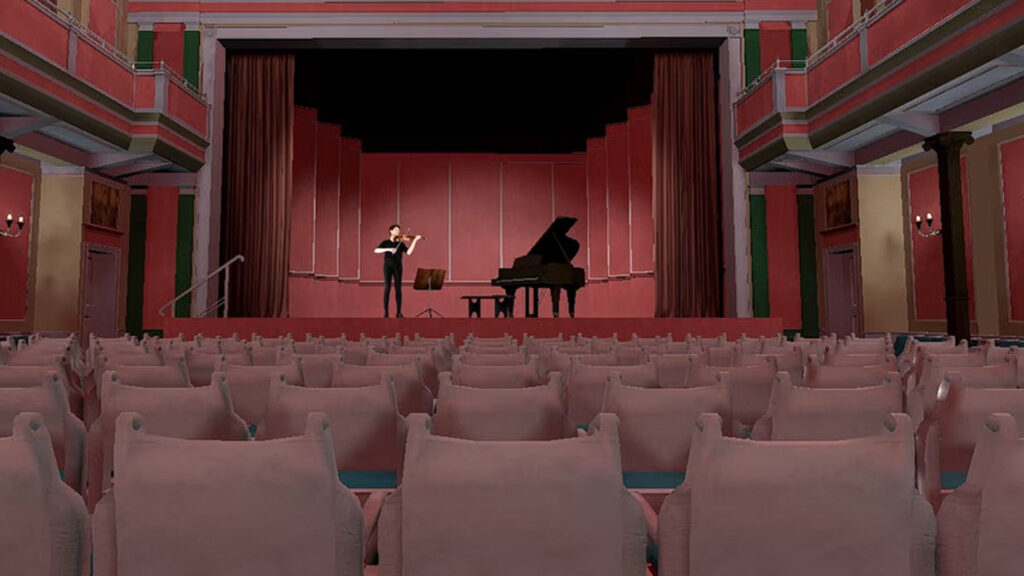
Color variant in VR setting (Image: Youtube/TU-Berlin)

The study published in the «Journal of the Acoustical Society of America» by a team led by Stefan Weinzierl from the Department of Audio Communication at TU Berlin was able to show that the color design of an auditorium measurably changes the room acoustic impression - in particular the perception of sound color.

The study investigated whether visual stimuli not only accompany the concert experience, but also influence the auditory impression itself. To do this, the researchers used VR glasses to place test subjects in virtual versions of the chamber music hall in the Berlin Konzerthaus, which differed in terms of color tone, brightness and saturation. A total of twelve differently designed color environments in shades of red, green and blue were tested, including different color schemes for seat covers and stage backdrops.

The visual design had a particularly clear effect on the perceived timbre. Cooler-looking, more saturated blue and green tones tended to be associated with a perceived «colder» sound impression. Darker halls with less saturated colors tended to achieve higher liking ratings. In contrast, the visual design had no influence on the perceived loudness.

More info:
https://publishing.aip.org/publications/latest-content/how-the-color-of-a-theater-affects-sound-perception/

Obwalden stands by its folk culture festival

The Canton of Obwalden continues to support the Obwald Folk Culture Festival financially with funds from the Swisslos Fund.

Obwald 2025 with guest country Cuba (Image: Verein Volkskulturfest Obwald)

The sponsoring association will receive a total contribution of 210,000 francs for the next three festivals from 2026 to 2028. The canton of Obwalden is thus continuing its support for the music festival at the same level as in previous years. The Obwald Folk Culture Festival needs the contributions to be able to plan and run the festival.

A newly staffed board under the leadership of President Tobias Lengen took over the organization of the festival at the start of the last funding period (2023 to 2025). Since then, new accents have been set both in the musical program and in the visitor infrastructure, writes the canton. While the 2023 and 2024 festivals with the guest countries Bulgaria and Finland had the same high visitor frequency as the previous years, the 2025 festival with the guest country Cuba set a new record: for the first time in the history of the Obwald Folk Culture Festival, all performances were sold out.

More info:
https://www.ow.ch/aktuellesinformationen/133678

Hecht clear the board at the Swiss Music Awards 2026

The dialect musicians Hecht won four of the coveted music trophies at the Swiss Music Awards 2026. Other winners included Trauffer, Zoë Më, Jule X and Baby Volcano.

Pike (Image: SMA)

Trauffer was awarded Best Solo Act this year; the dialect folk singer has been nominated 12 times and has already won twice at the Swiss Music Awards. Hecht were nominated four times and won in all four categories: Best Group, Best Live Act, Best Streaming Artist and in the Best Hit category for «Mon Amour».

The poetic pop artist Zoë Më was named Best Breaking Act. And the popular Bernese rapper Jule X earned the award for Most Rising Artist Social Media. Zurich musician Nina Valotti was delighted to receive an award in the SRF 3 Best Talent category, rapper Baby Volcano won the Best Act Romandie category and the Artist Award, with which Swiss artists and music creators directly determine who from their ranks receives an award for artistically outstanding music creation, went to neo-soul artist MISS C-LINE.

The Swiss Music Awards are the biggest pop-rock music awards ceremony in Switzerland. New talents and successful artists are honored in 14 categories at this promotional platform for Swiss music. CH-Media Entertainment organizes the SMA under license from the industry association IFPI Switzerland.

Global music industry grows by 6.4 percent

Global revenue from music sales rose by 6.4 percent to 31.7 billion US dollars in 2025, the eleventh consecutive year of growth.

Streaming services (Image: flickr)

Revenue from paid streaming grew by 8.8 percent and contributed 52.4 percent to global market sales, according to the German Music Industry Association. There are now 837 million people worldwide using paid streaming subscriptions. Due to the sustained demand for vinyl (up 13.7 percent), the physical business also grew significantly overall (up 8.0 percent). The figures are taken from the IFPI (International Federation of the Phonographic Industry) Global Music Report 2026.

However, the threat to the industry from streaming manipulation is increasing worldwide, the association continues. Artificially generated view figures for manipulated or falsified content deprive creators and everyone else who invests in the music industry of important revenue. The music industry expects all players at every point in the streaming value chain to take proactive measures to detect and prevent fraud.


Orchestre de la Suisse Romande appoints Conductors in Residence

After the Orchestre de la Suisse Romande was unable to find a successor to its previous chief conductor Jonathan Nott, it is now presenting two conductors in residence.

The OSR with Simone Young (Image: Anne du Chastel)

The Italian conductor Daniele Gatti will take on the role for three years from the 2026/27 season, while the Australian conductor Simone Young will take on the role in parallel from the 2027/28 season. The title entails four weeks of presence per season.

The Orchestre de la Suisse Romande (OSR) was founded in 1918 by Ernest Ansermet. It is administered as a foundation and is mainly funded by the Canton and City of Geneva, is associated with Radio Télévision Suisse and functions as the opera orchestra at the Grand Théâtre de Genève.

Data-driven methods for musicology

A model of the historical spread of certain chorale elements shows how powerful data-driven methods can be for historical musicology.

Choral book in the gallery of Naumburg Cathedral. (Image: Public Domain)

Tim Eipert, who is doing his doctorate under Fabian Moss, Junior Professor of Digital Music Philology and Music Theory at Julius-Maximilians-Universität Würzburg (JMU), has analyzed over 4,000 trope elements - inserted texts and melodies that occur in Gregorian chorales - from 163 manuscripts using a new digital model. It divided the tropes into several levels and four main clusters and used the individual insertions within the chorales to form clusters that can then be displayed on a map. The manuscripts come from areas that mainly comprise the present-day states of France, Germany, Switzerland, Austria, Italy and the south of Great Britain.

It turned out that the spread of the clusters was severely restricted by the political borders of the time after the Treaty of Verdun. There was apparently little cultural exchange about the chorales beyond imperial borders at the time, explains Eipert. The musical tradition thus reflects the political fragmentation of Europe.

Eipert has already integrated the model into a university course: JMU student Jason Ackermann, for example, used it to analyze the comment columns under videos by Taylor Swift and Radiohead on YouTube and identify superfans.

Original publication:
Eipert, T. and Moss, F.C. (2026) ‘Inferring Communities of Medieval Music Manuscripts Using Stochastic Block Models’, Transactions of the International Society for Music Information Retrieval, 9(1), February 26, 2026, https://doi.org/10.5334/tismir.298

Toth represents Switzerland at Eurovision Young Musicians

Manoush Toth, a student at the Basel University of Music, will represent Switzerland at the Eurovision Young Musicians competition in Yerevan on June 6, 2026.

Manoush Toth (Image: FHNW)

Manoush Toth completed her Bachelor's degree in piano performance in the classes of Zoltán Fejérvári and Claudio Martínez Mehner at the Basel University of Music FHNW and is currently continuing her studies in the Master's Performance program in the class of Claudio Martínez Mehner. She received a prize for the best BA recital for her bachelor's degree in 2025.

Founded in 1982, the competition Eurovision Young Musicians (EYM) is organized by the European Broadcasting Union (EBU) for young Europeans between the ages of 12 and 21. It is held every two years and broadcast on television. In contrast to the Eurovision Song Contest and Junior Eurovision Song Contest, the Eurovision Young Musicians is decided by an international jury of experts.

Addendum on April 21, 2026: Link to the SRF press release of April 13

Jinhee Kim takes over a guitar class at the ZHdK

From the coming fall semester 2026, Korean Jinhee Kim will be teaching guitar as a major subject at Zurich University of the Arts.

Jinhee Kim (Image: ZHdK)

Jinhee Kim was born in Seoul and studied at the Musikhochschule Freiburg and the Musikhochschule Basel. In addition to her concert exam, she completed two master's degrees with top marks (Master Performance, Master Music Pedagogy).

Her work as a teacher also led her to study music physiology at the Zurich University of the Arts. There she acquired extensive knowledge of functional anatomy and brain physiology in connection with music-making with a Diploma of Advanced Studies in Music Physiology. She has won numerous international competitions and has been a professor of guitar at the Trossingen University of Music since April 2021.


.

Finnish study on everyday music listening

With the help of a research app, a Finnish team wants to investigate how teenagers and young adults across Europe listen to music to regulate their emotions.

MuPsych« research app. Participants are still being sought for the study. (Image: Munich University of Music and Performing Arts)

The «Music & Emotions» project is part of the study Musiconnect: Music and emotion regulation at the University of Jyväskylä in Finland and investigates listening to music in everyday life and its connection to emotions and well-being. With the help of the cell phone app MuPsych musical, individual and situational factors that influence this phenomenon are identified. Data is being collected across Europe. The partner in Germany is the University of Music and Performing Arts Munich (HMTM)

The study will run until the end of 2026 and the anonymized data will be used to publish a large international comparative study as well as detailed country-specific sub-studies. The first results will already be visible this year, including in a leading peer-reviewed journal, flanked by national sub-studies in relevant journals and at the Musiconnex Conference in Finland. The research project is supported by the European Research Council ERC and the Research Council of Finland.

We are still looking for participants. Spotify memberships will be raffled among them, and everyone will receive a personal music listening diary with curated music recommendations.

Access to the app: https://musicstudy.eu/de/


Austria gets its first music strategy

Now that the Austrian National Council has approved the development of a national music strategy, the first steps have been taken.

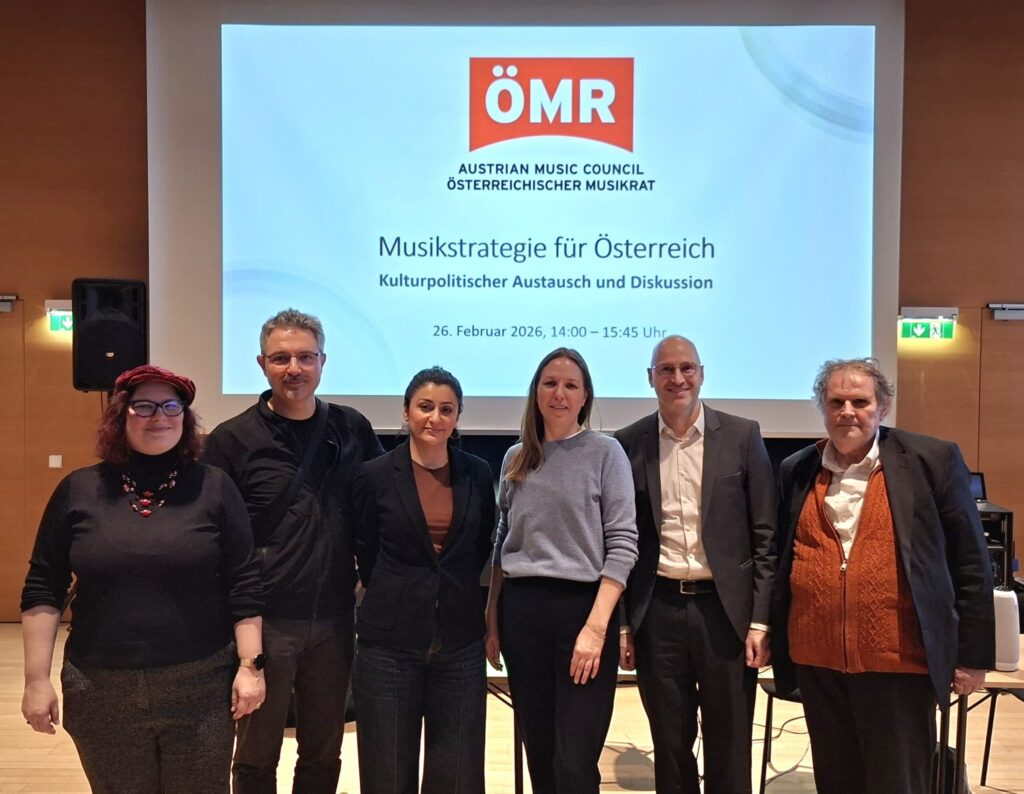
(from left to right): Eva-Maria Bauer, Günther Wildner, Tyma Kraitt, Tatjana Domany, Stefan Hahn, Harald Huber (Photo: Sabine Walter)

The Austrian Music Council (ÖMR) hosted an information and discussion event on the «Music Strategy for Austria» as part of its General Assembly on February 26, 2026. The meeting was preceded by a working meeting with the Austrian music universities, where the burning issues of teacher shortages, teacher training, curricula, teacher training courses and plans to reform school teaching were discussed.

The current process for an Austrian music strategy is being coordinated by the Federal Ministry of Housing, Arts, Culture, Media and Sport (BMWKMS). It is based on a unanimous resolution passed by all parties in the National Council in July 2025. The process began in fall 2025 with a broad-based online survey in which 6,000 music professionals took part. In addition, five stakeholder workshops have been held since the beginning of 2026 to consolidate and validate the survey results.

The topics of the workshops were training, professionalization and talent development, live events, creation & production, media and national visibility as well as distribution & marketing. A further workshop on AI & streaming is being planned. Cross-cutting topics such as inclusion in the music sector will also be discussed in more detail. The final music strategy is to be presented in fall 2026.

Paavo Järvi takes over the London Philharmonic Orchestra

Paavo Järvi has been appointed Chief Conductor and Artistic Advisor of the London Philharmonic Orchestra for the 2028/29 season. He succeeds Edward Gardner in this position.

Paavo Järvi (Picture: Kaupo Kikkas)

With a contract initially limited to five years, Järvi's appointment marks an important new phase for the orchestra, which will celebrate its centenary in 2032, according to the press release.

Paavo Järvi has been Music Director of the Zurich Tonhalle Orchestra since the 2019/2020 season and until 2029. He studied percussion and conducting in his home town of Tallinn. In 1980, the whole family emigrated to the USA. He continued his studies with Leonard Bernstein in Los Angeles. In 2001, he became chief conductor in Cincinnati, where he still maintains links today as Music Director Laureate.

­

Mojca Lavrenčič wins La Maestra 2026

The Slovenian conductor Mojca Lavrenčič, who is currently studying with Andrea Marcon at the Schola Cantorum Basiliensis, has won the La Maestra competition in Paris.

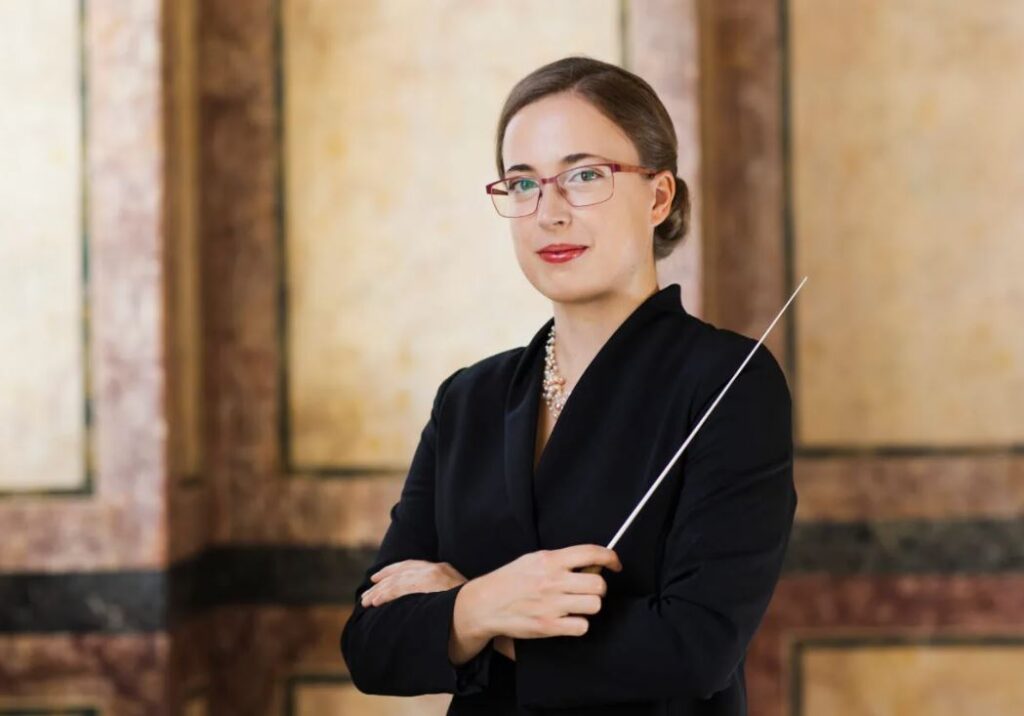
Mojca Lavrenčič (Image: Darja Stravs Tisu)

Mojca Lavrenčič was born in Vienna in 1993 and grew up in Slovenia. She studied conducting at the University of Ljubljana with Marko Letonja and gained her first professional experience at the SNG Opera and Ballet Ljubljana, where she assisted guest conductors and conducted opera and ballet productions. To deepen her artistic approach, she is continuing her training in Switzerland with Andrea Marcon at the Schola Cantorum Basiliensis, where she is refining her interpretative voice in a stimulating international environment.

The international conducting competition La Maestra was launched in 2019 by the Philharmonie de Paris and the Paris Mozart Orchestra. The competition is complemented by an academy that provides professional support to the prizewinners for two years. It is co-directed by Claire Gibault (Artistic and Musical Director of the Paris Mozart Orchestra) and Olivier Mantei (General Director of the Philharmonie de Paris).

Despite progress, writes the competition, the proportion of women at the helm of permanent orchestras is still very low. While only 4.3 percent of orchestras worldwide were led by women in 2018, this figure is now only 8 percent. In France, the number of women at the helm of permanent orchestras rose from 2.7% in 2019 to 12.5% in 2023: a spectacular leap, but we are still a long way from equality.

Bach Foundation St. Gallen honored with Leipzig Bach Medal

The City of Leipzig awards its 2026 Bach Medal to the J. S. Bach Foundation St. Gallen

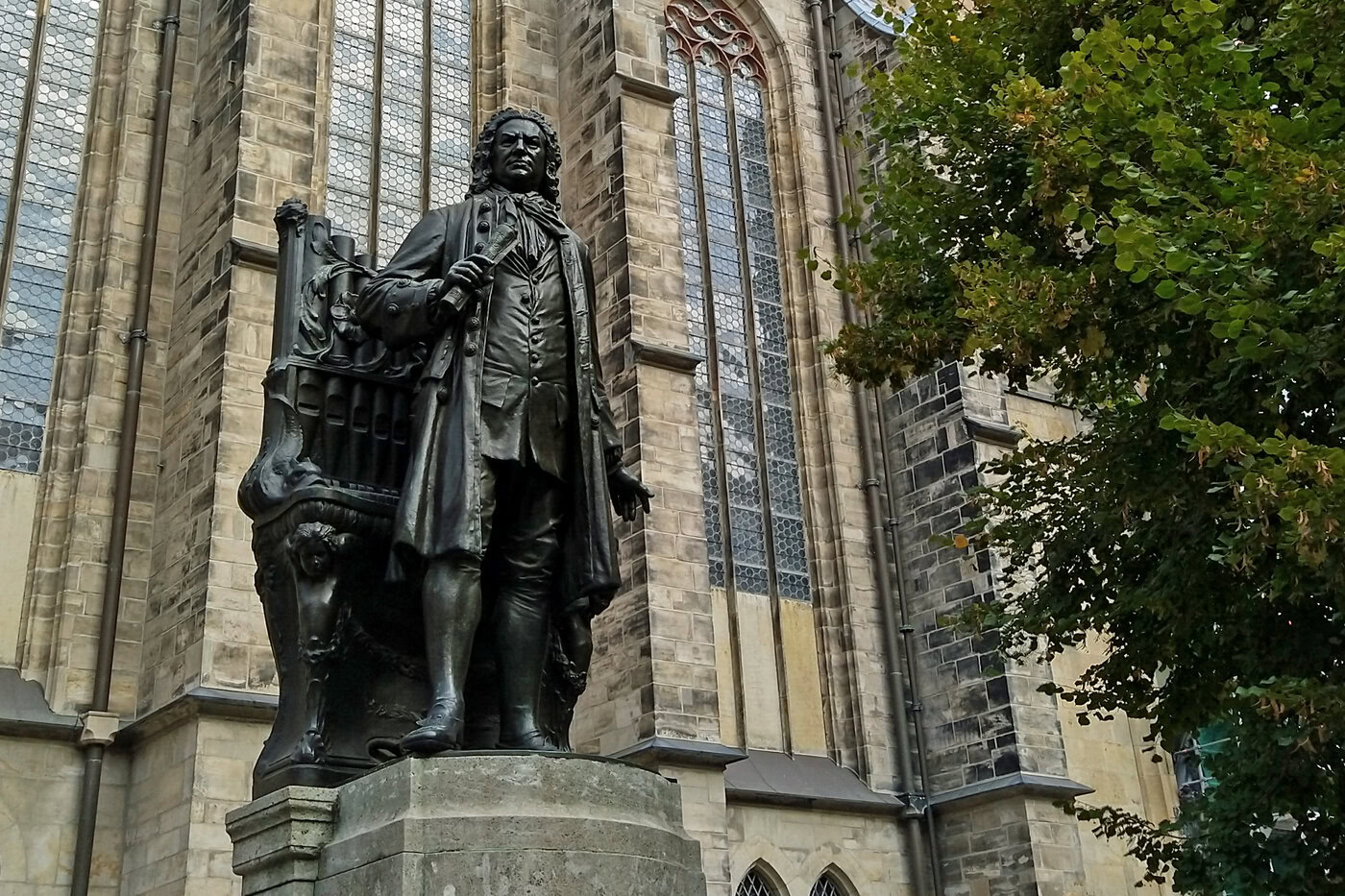
Johann Sebastian Bach monument in Leipzig. Photo: SMZ/ks

With this award, the city of Leipzig is honoring «a long-term project that is unique in the international cultivation of Bach», according to its press release: since 2006, the foundation has been pursuing the goal of performing the complete vocal works of Johann Sebastian Bach in monthly concerts. The award will be presented as part of the Leipzig Bach Festival 2026.

For twenty years, the foundation's choir and orchestra have set the highest artistic standards under the direction of Rudolf Lutz, the city of Leipzig continues. With this consistently long-term project, the foundation has set standards in the mediation and performance of Bach's vocal music. The combination of historically informed performance practice, a scientifically sound introduction to the work and modern media dissemination has made the St. Gallen-based company a model of sustainable music education in the 21st century.

The Bach Medal of the City of Leipzig has already been awarded to Marcel Ponseele (2025), Andreas Staier (2024), the Thomanerchor Leipzig (2023), Sir András Schiff (2022), Hans-Joachim Schulze and Christoph Wolff (2021), among others, for special services to the cultivation of Bach's works, Angela Hewitt (2020), Robert Levin (2018), Masaaki Suzuki (2012), Herbert Blomstedt (2011), Philippe Herreweghe (2010), Nikolaus Harnoncourt † (2007), Ton Koopman (2006), Sir John Eliot Gardiner (2005) and Helmuth Rilling (2004).

Music sales in Germany increased slightly in 2025

In Germany, music worth EUR 2.42 billion was sold in 2025, 2.3% more than in 2024.

(Image: Petr Kratochvil/publicdomainpictures.net)

According to the statement from the German Music Industry Association, the figures relate to retail revenue from the sale of music on CDs, vinyl LPs and downloads as well as in the streaming sector. As in previous years, music streaming was again the driver of growth in 2025, with retail sales growing by 4.1 percent to 84.4 percent of industry revenue. This means that streaming alone generated more than 2 billion euros in revenue. The split between physical (CDs and vinyl) and digital (streaming and downloads) business in Germany is now 14.2 percent to 85.8 percent.

The physical market segment declined by 5.9% overall and generated 345 million euros. Within this segment, vinyl was also able to grow last year (up 2.8%); however, with a 44.2% share of the physical market, vinyl has not yet caught up with CDs despite a decline of 11.3%. The CD was therefore still the second-strongest sales segment in 2025.

Original article:
https://www.musikindustrie.de/presse/presseinformationen/musikindustrie-in-deutschland-2025

get_footer();