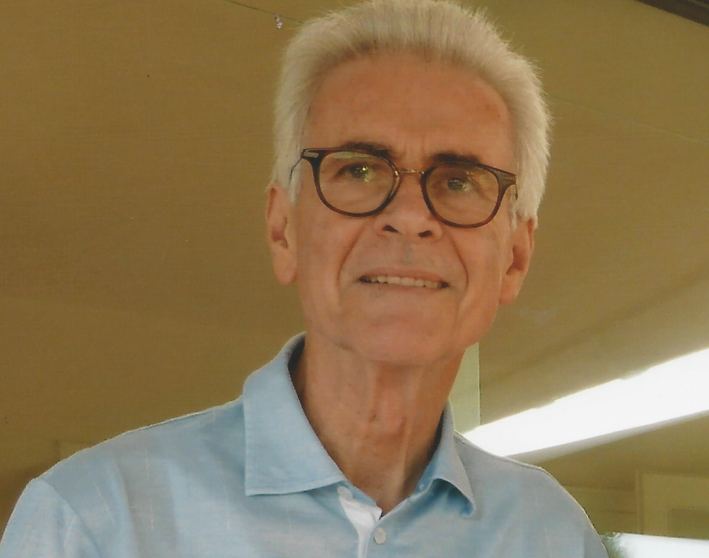
Rapture into a better world - song recitals in Ukraine
With the help of Silke Gäng, Roman Melish organizes recitals in the Ukraine.
Georg Rudiger
(translation: AI)
- Feb 02, 2023
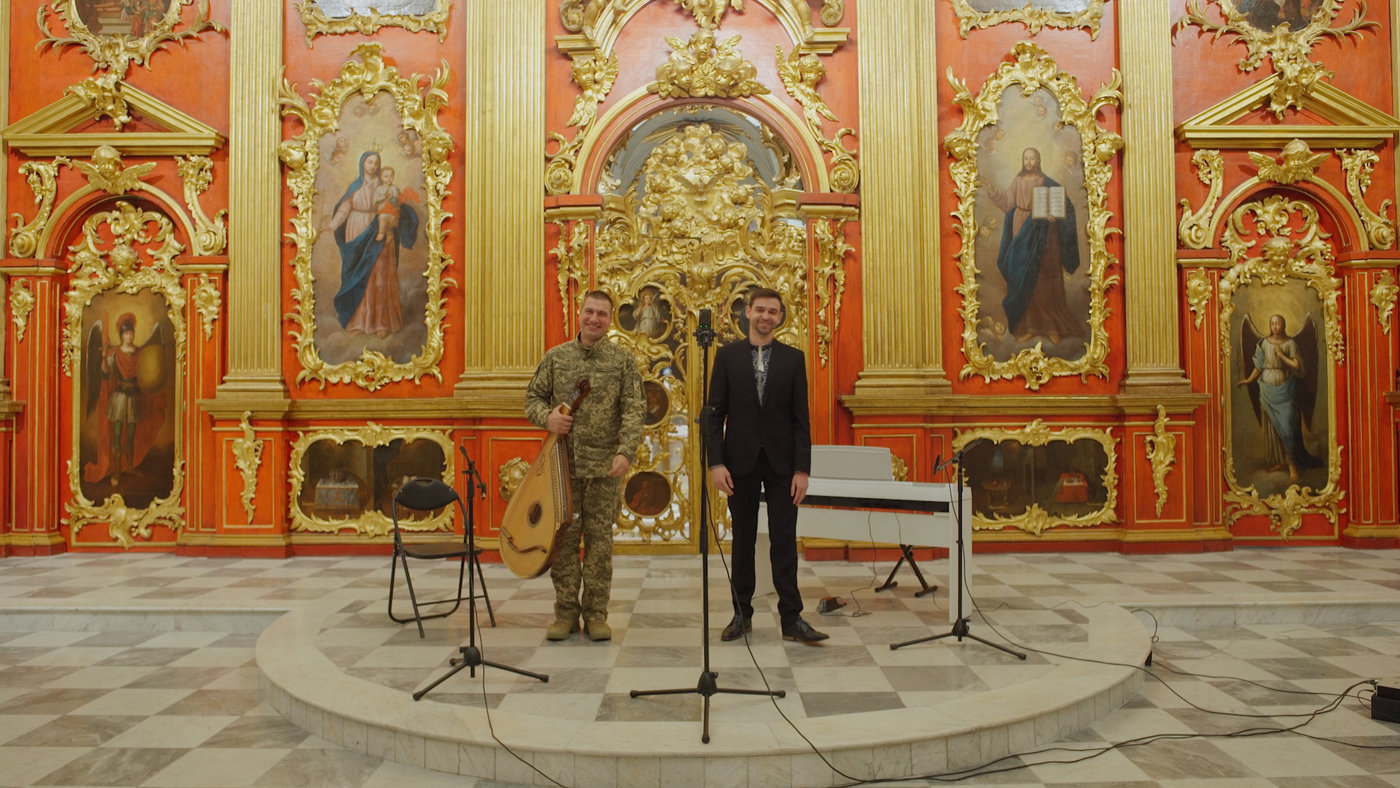
Roman Melish (right) and Taras Stoliar in St. Andrew's Church in Kyiv. Picture: Maryana Rogovska
The gentle chords spread a sense of security. Roman Melish's bright, boyish voice is touching in its fragility. "You beautiful art, in how many gray hours," sings the Ukrainian countertenor. "You have enkindled my heart to warm love, you have transported me to a better world!" For this special song recital on November 25, 2022 in the gleaming golden St. Andrew's Church in Kyiv diesel generators are available so that the electric piano played by Andriy Vasin does not remain silent in the event of a power cut. Battery-powered lamps are also provided. Only in the event of a bomb alert would it have to be stopped. But it remains calm. The war refugees invited to the concert can dream themselves into a better world for an hour. A piece of normality in the chaos, a little balm for the soul.
Bandura player and soldier
Until a few days ago, Taras Stoliar was still fighting on the eastern front in the Donbas. Now the soldier in combat fatigues sits next to the singer and plays the bandura, the Ukrainian national instrument. This lute, which dates back to the 6th century, also sounds soothing with its delicate, silvery tones. In Soviet times, the bandura was bitterly fought against as a means of expressing Ukrainian national consciousness. In his posthumously published memoirs, Dmitri Shostakovich reports on a mass execution of bandura players in the 1930s.
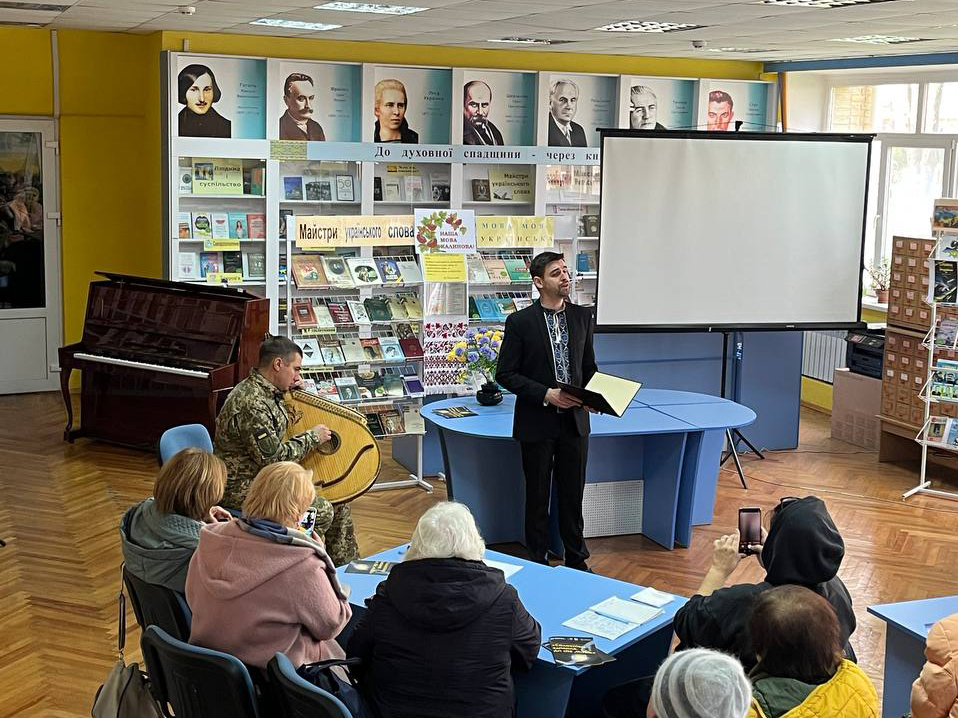
Stoliar is actually a professional musician and plays in the Naoni Orchestrathe national orchestra for folk instruments. He has been defending his homeland since the Russian attack. He needed special permission from the military authorities for the concert. "We were able to show that musicians can also fight for our country as soldiers - and that soldiers can also be musicians," says Roman Melish in the video interview. The singer put together German and Ukrainian songs for this concert, which was also held on two previous evenings in a library in the former Russian-occupied Irpin. "The audience was very moved. I saw a lot of tears. For the duration of the concert, the audience forgot that they were refugees," he says.
Support from Basel
The fact that these recitals take place in the middle of the war is Silke Gäng to thank. The mezzo-soprano and artistic director of Song Basel studied together with Roman Melish in Basel. In recent years, when he lived in Kyiv again, he also came to Switzerland for concerts. "We were more colleagues than friends," says Gäng during a conversation in her hometown of Fribourg. When Russia attacked Ukraine and she saw terrible pictures from the war on Roman's Instagram profile, she was deeply moved and contacted him. "There were lots of solidarity concerts here at the time. I wanted to help the local people with music. But is music even needed when you're fighting for survival?"
At the Basel Song Festival, she and her fellow performers place the art song in a wider social context and explore the question of what music can achieve. The war was a reality check, so to speak. She collected donations in Basel for the ambitious project in Ukraine, worked on the program with Roman and spoke the German lyrics to him so that he could practice the correct pronunciation. She only found out through Roman's research that there was even a Ukrainian composer, Mykola Lysenko, who had studied with Carl Reinecke in Leipzig in the 19th century and introduced the German art song tradition to Ukraine.
Music to feel
For him, the art song was new territory. The countertenor specializes in early music. That's why he came to study at the Schola Cantorum Basiliensis in 2013. That's why he returned to Ukraine in 2019 to raise awareness of historical performance practice there. He has his singing to thank for the fact that he didn't have to take up arms himself. After the tenth day of the war, he received a draft notice. The soldier in charge at the military office recognized him as a singer, as he had appeared on Ukrainian television in the show The Voice a few days earlier with a Vivaldi aria - and sent him away again.
Roman experienced the outbreak of war on February 24, 2022 in his parents' house in the countryside in western Ukraine. "I was totally paralyzed and incredibly scared." He actually wanted to return to Kyiv the next day. Now there was panic everywhere. The cars were jammed. The supermarkets were empty. "My brother and I prepared our documents and packed a suitcase in case we had to flee." It was only on April 6 that he returned to Kyiv in a darkened train for a concert on Annunciation Day. And experienced a city in a state of emergency - with checkpoints, night-time curfews and people living in the subway because their homes had been bombed.
In the beginning, he felt completely useless as a musician during the war, but that has changed. "For me, music offers the opportunity to think about what is happening. I can share my emotions through music. People here need music because they want to feel something. It's important for inner stability." The war has changed him. He is more direct and less willing to compromise than before. Every day could be his last. But this awareness also makes him more sensitive to the fate of others.
When Silke Gäng contacted him, he felt "like a hug in this terrible war". The support from Basel means a lot to him. "It helps me so that I can help others. Our recital project has given me back my strength and energy. And has given my life a deep meaning again."
Melish now gives regular early music concerts in Kyiv again. For the next recital, he could imagine performing in front of soldiers. Or a concert in Butscha, the place that became known worldwide as a result of the Russian massacre. But first, Roman Melish is coming to Basel on April 21 to perform in the context of Song Basel to give a recital and thank the donors. In addition to Andriy Vasin and the soprano Ivanna Plish, Taras Soliar will also be there if he is granted special permission again. "Living dangerously" is the motto of the festival, which was decided long before the war began.
Concert in the library in Irpin. Picture: Yevhen Petrychenko
Conference Music Discourses after 1970
A three-day public event at the Bern University of the Arts HKB from March 23 to 25 will shed light on discourses on contemporary music and its relationship to improvisation, television and society. Presentations with perspectives from 14 countries and panel discussions will be complemented by two concerts.
HKB
(translation: AI)
- Jan 31, 2023
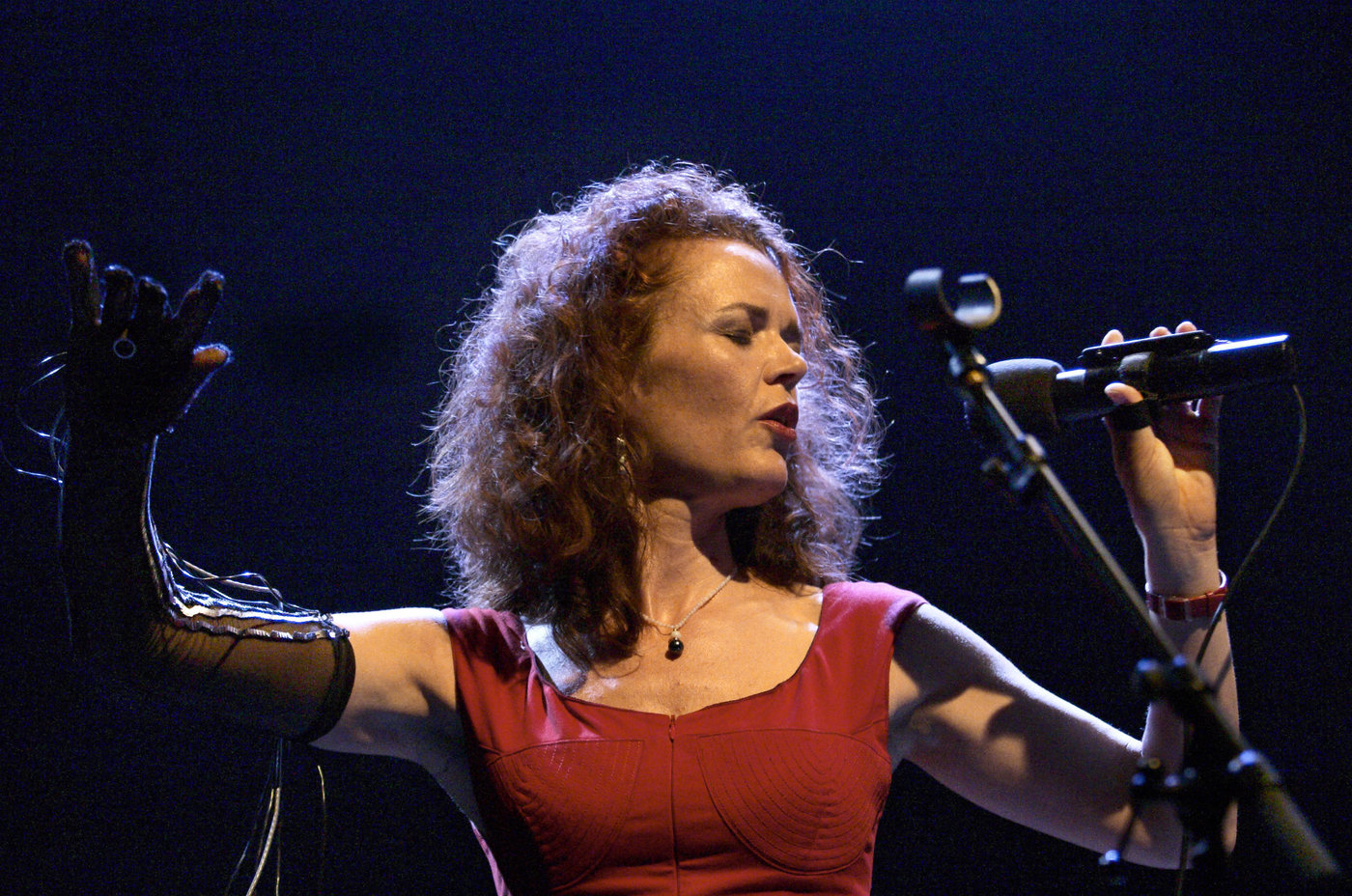
Improvisers like Franziska Baumann shaped the development of contemporary music. Photo: Francesca Pfeffer
Since the 1970s, there has been a boom in contemporary music: festivals have sprung up, ensembles have been founded and concert series have been launched. The SNSF project "At the focus of developments. The Swiss Association of Musicians 1975-2017" at the HKB examines competing aesthetic developments, the growing importance of non-composed music, the role of socio-political upheavals for contemporary music creation and changes in the media.
The conference reflects these topics from the perspective of 14 countries in five panels: How are controversial positions between tradition and avant-garde being fought over the sovereignty of interpretation of the contemporary? And with what consequences?
For a long time, contemporary music blocked itself off from improvised music. Initial efforts to integrate it (at the STV) proved to be clumsy attempts to break out of the self-imposed and snivelingly lamented "ghetto". Later, the mutual rapprochement was more courageous. How did contemporary music and improvisation perceive and influence each other? What role did improvisation play in the development of new music?
New music and television: This is first and foremost a narrative of rise and fall, initially favored by curiosity towards the new medium and fool's freedom, then shaped by the pressure of quotas and bureaucratic structures. But do the marginal contributions on TV even play a role in the discourse? To what extent can an understanding of new music be gleaned from the boom and later decline, as well as from changes in selection, content and form, and to what extent is there a social, cultural and media change?
The last panel also reflects on the latter: What role do institutions play in the development and shaping of various discourses? What is the position of organizers, be it radio, labels, festivals or composers' associations? And what are the overarching discourses? The national? The international? The position of women? A closing panel with historian Philipp Sarasin, among others, will address these questions.
Presentations and discussions will be complemented by live musical contributions: Improvisational discourses will be brought to the stage, and a second concert evening will present works that once did not make it onto the stage because the jury did not nominate them for the programs for aesthetic, personnel policy or practical reasons.
The "liturgical" compositions by the musician from Obwalden will be performed at various venues in Switzerland this year.
Angelo Garovi
(translation: AI)
- 27 Jan 2023
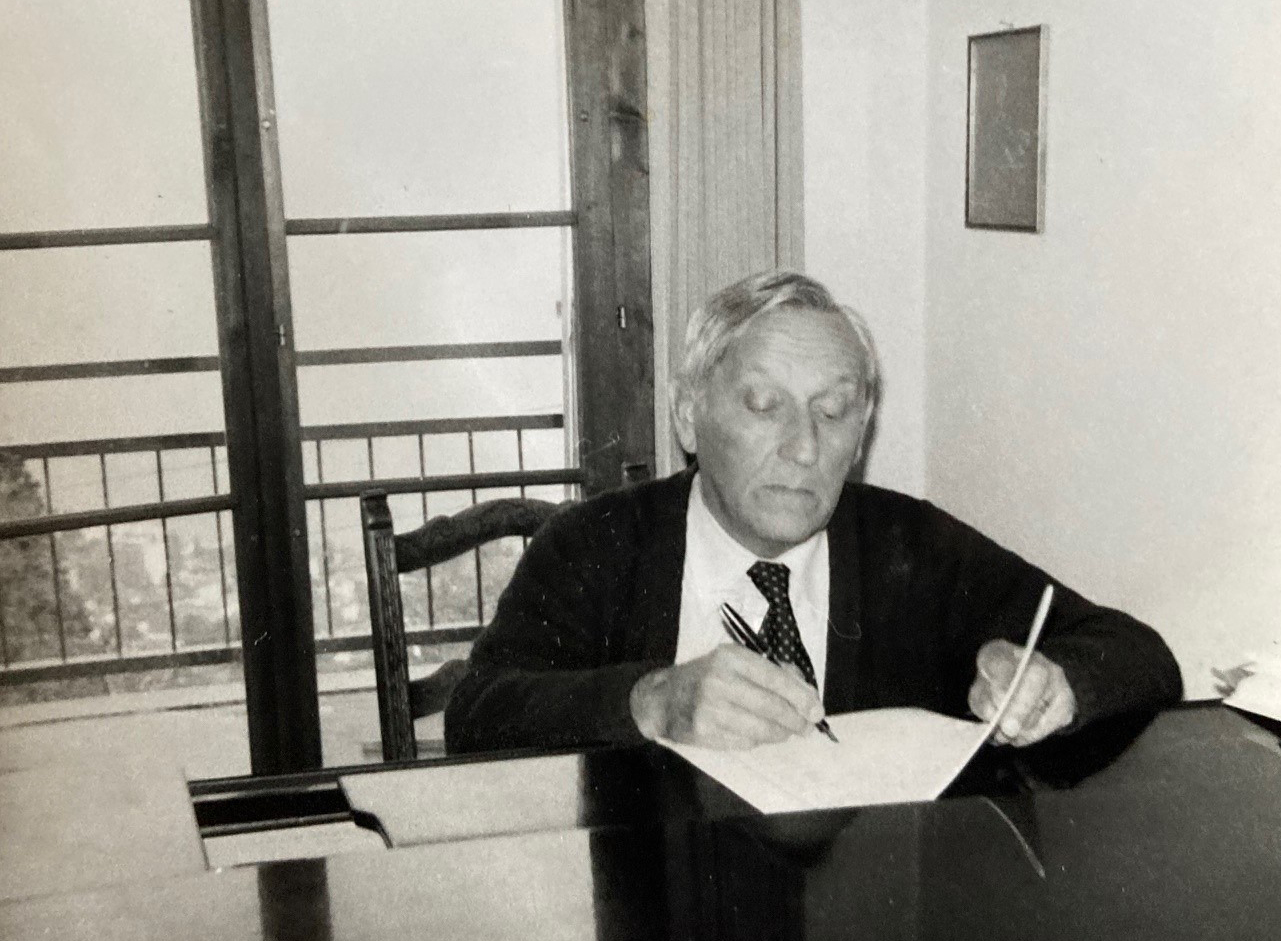
Josef Garovi played his organ works in church services. Photo: Garovi archive
March 7, 2023 marks the 115th birthday of Josef Garovi (1908-1985). The musician and composer from Obwalden worked in Obwalden, Lucerne, Zurich and Valais. He was awarded the Orlando di Lasso Medal in 1977 and the Central Switzerland Culture Prize in 1978.
While organizing the estate, various unpublished liturgical organ compositions came to light, which the composer had played himself in church services - and which then remained in the estate.
These "liturgical" compositions will now be performed this year. Choral preludes, preludes, postludes, offertories and versets will be performed in the following churches, some of them at places where he worked: In Obwalden at the parish and pilgrimage church in Sachseln, in the Frauenkloster convent and in the Kollegiumskirche church in Sarnen; in Lucerne at the Jesuit Church (organ class of Suzanne Z'Graggen, Lucerne University of Applied Sciences and Arts) and at St. John's Church (Beat Heimgartner); in the Wallis at the Kollegiumskirche Brig (Hilmar Gertschen) as well as in Zurich at the Johanneskirche (Tobias Willi).
Further concert performances of his works are planned in the Engelberg monastery church (Alessandro Valoriani), at the Hofkirche in Lucerne (Stéphane Mottoul) and in Bern at the Trinity Basilica (Olivier Eisenmann). This means that almost the entire organ oeuvre of Dupré's pupil Josef Garovi will be played in various churches this year.
Josef Garovi studied at the Lucerne Organ School, among others. Photo: Garovi archive
Exact details of the venues and concerts will be announced in due course.
on the Josef Garovi website published.
Change in the Board of Directors of the Allgemeine Musik-Gesellschaft Zürich
At the end of 2022, the Board of the Allgemeine Musik-Gesellschaft Zürich was reorganized. Heinrich Aerni was elected President.
PM/SMZ
(translation: AI)
- 25 Jan 2023
The Board of the General Music Society Zurich (AMG) was reconstituted at the end of 2022. Heinrich Aerni (Zentralbibliothek Zürich) was elected President to succeed Inga Mai Groote (University of Zurich), while Esma Cerkovnik (University of Zurich) is the new Vice President. Eva Martina Hanke is responsible for the Actuary's Office, Archives and Library, Angelika Salge (both Central Library Zurich) for the Bursar's Office. The Advisory Board includes Enrico Fischer, Veronika Frey, Claire Genewein, Susanne Hess, Ulrike Thiele (Tonhalle Society Zurich) and Andrea Wiesli.
The AMG was formed in 1812 from a merger of Collegia Musica, which dated back to the early 17th century.
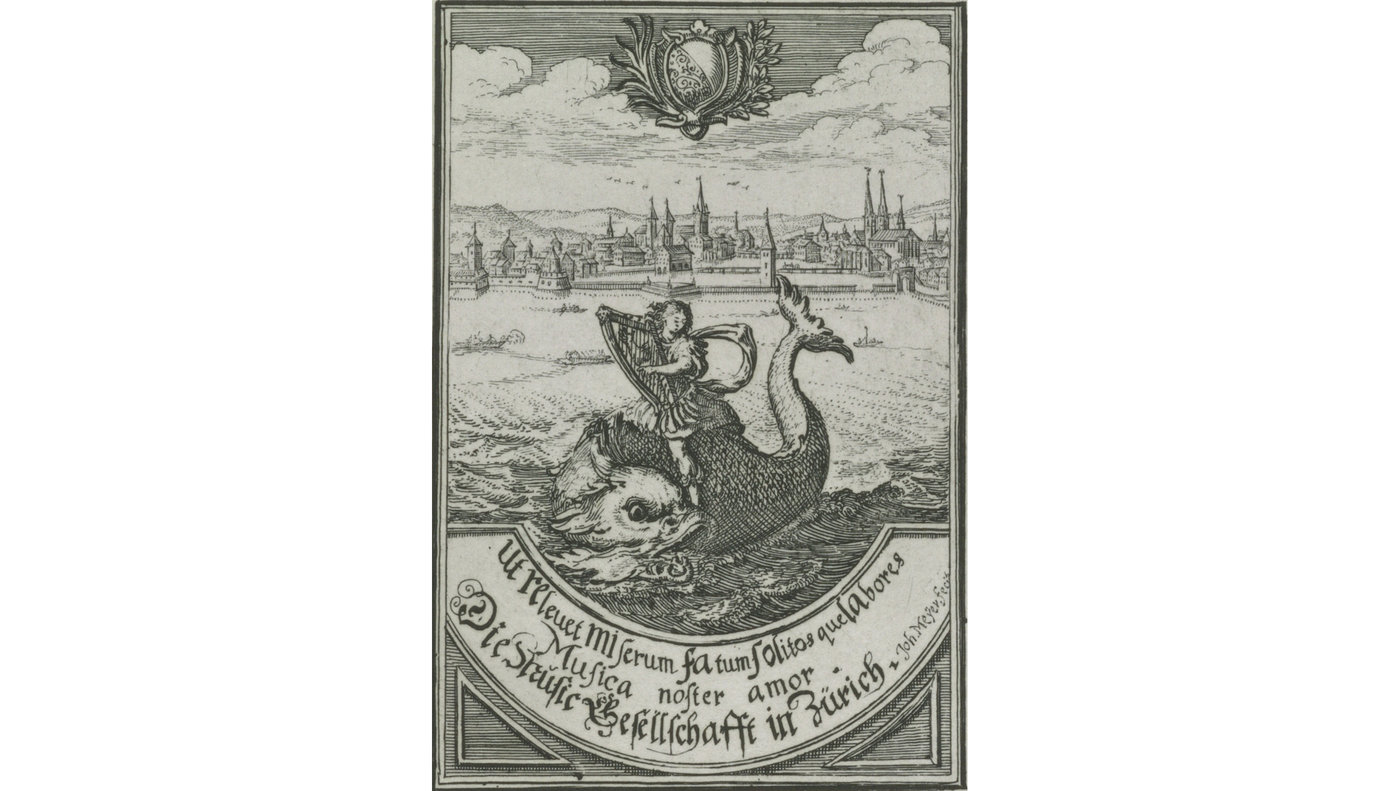
Arion on the dolphin in the lower lake basin in front of a panorama of the city of Zurich. Etching by Johannes Meyer, printed on the first New Year's sheet of the Gesellschaft ab dem Musiksaal (1685), a predecessor society of the AMG. (Image: Zurich Central Library)
The 10th Forum Music Education
With the umbrella topics of digitalization and inclusion, the 10th FMB on 20/21 January 2023 was dedicated to burning educational issues.
Niklaus Rüegg
(translation: AI)
- 25 Jan 2023
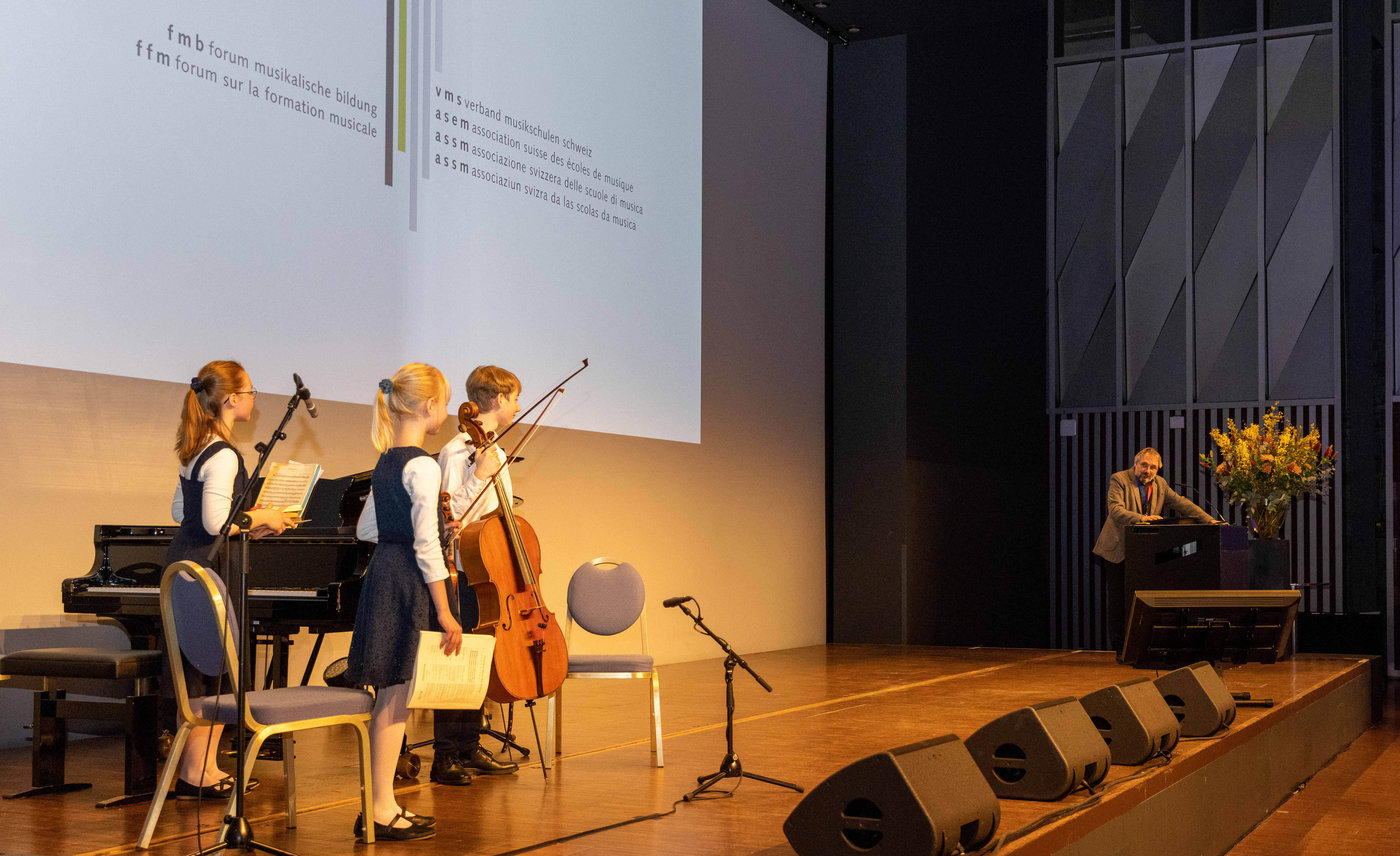
The Trio Pilgram played at the opening of the 10th Forum Musikalische Bildung. Photo: Anne Fröhlich FRAME PHOTOGRAPHY
The Forum Musikalische Bildung (FMB) was postponed by one year in 2022 due to the coronavirus - it's hard to believe. Three years have therefore passed since the last edition. On January 20 and 21 of this year it was that time again. Launched in November 2007 by Hector Herzig, then President of the Swiss Association of Music Schools (VMS), it was held annually until 2012, then every two years (see History of the FMB). The founder had put a lot of heart and soul and idealism into this forum and made it the flagship of the association. It's a shame that Herzig didn't show up to be celebrated at the tenth edition; it's also strange that he wasn't mentioned at all.
Digitalization has passed its peak
The new VMS President Philippe Krüttli welcomed an impressive number of participants and then handed over to the event's moderator, Myriam Holzner. The first keynote speaker, futurist Joël Luc Cachelin, had already given a speech at the FMB 2018 on the topic of digitalization and education. At that time, digitality in the classroom was still perceived as something threatening in many places. The pandemic has had an accelerating effect in this area, and some things have now become a natural part of everyday teaching. Cachelin did not want to engage in a review of his predictions at the time. He preferred to take another look into the future - or rather into different futures, which he categorized by color. The pink future, for example, asks how we deal with our skills, which are increasingly being rivaled by intelligent answering machines and chat boxes. The green future is about using resources intelligently and optimizing sustainability.
And where do we stand today in terms of digitalization? According to the cycle model of the Russian economist Nikolai Kondratiev (1892-1938), Cachelin explained, digitalization has already passed its peak. Today, the focus is still on closing unfinished digital cycles and optimizing network security. Essentially, nothing will change in the nature of music education. There will still be no substitute for creativity and self-efficacy in the future. However, the speaker sees innovations in the field of digital aids and in the interaction between people making music and machines (new instruments, robotics).
Networks replace systems
The term "digital transformation" has only been around since 2014, explained Andréa Belliger, Vice-Rector at the Lucerne University of Teacher Education and Director of the Lucerne Institute for Communication and Leadership in her presentation. She pointed out a fundamental difference: "The digital transformation is a process of social change. It changes norms and attitudes and is more than just digitalization." Technology enables a high level of connectivity, which poses a major challenge for the education system in particular. Countless do-it-yourself teachers are flooding the web with e-learning courses. "Flipped classroom", "seemless learning" or adaptive learning are just some of the many buzzwords. Platforms such as moog.org or khanacademy.org offer a comprehensive range of didactically perfectly prepared, free online courses that enable self-directed and participatory learning. Belliger identified a paradigm shift in forms of teaching and learning: "We are in the transition between system and network." Under these circumstances, institutions, including music academies, must ask themselves the fundamental question of their mission.
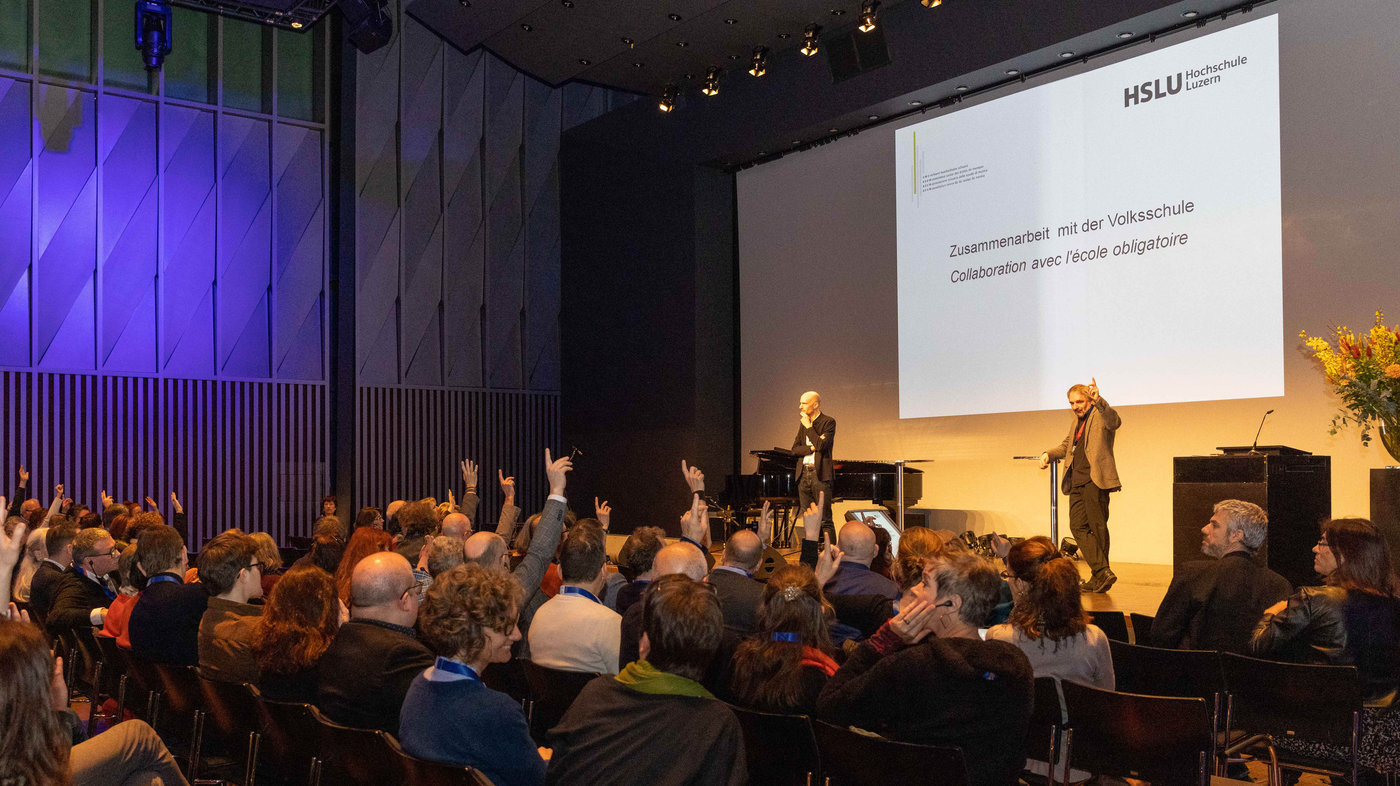
VMS President Philippe Krüttli and Valentin Gloor, Rector of the Lucerne School of Music, led the discussion. Photo: Anne Fröhlich FRAME PHOTOGRAPHY
How is music learned in Switzerland?
Valentin Gloor, who was a member of the VMS board four years ago and is now Director of the Lucerne University of Music (HSLU) and Vice President of the Swiss Conference of Music Universities, gave an outline of the broad-based research project "Music Learning Switzerland" together with Philippe Krüttli. (The SMZ has reported) Under the chairmanship of Marc-Antoine Camp, head of the Competence Center for Research in Music Education at the HSLU, and in collaboration with the VMS and 37 professional associations and institutions of music education, the extracurricular music learning landscape in Switzerland was examined.
Gloor summed up the aim of the study: "We wanted to know where we are heading." Eight fields of action emerged in the end. These include offers for pre-school children, cooperation with elementary school, talent promotion, musical offers across all age groups and the expansion of the music education professional profile. The latter will soon be included in the new version of the corresponding VMS document. In the ensuing discussion, cooperation with elementary school and the professional profile were discussed. On the subject of elementary school, there was a consensus that the institutions should move closer together. The second topic is related to the first, as there is a widespread lack of training courses that qualify instrumental teachers to teach at elementary school. On the other hand, there is an increasing lack of musical teaching skills among newly qualified primary school teachers.
Everyone has impairments
The second day was packed with five presentations and a discussion round. In addition, the best practice competition from the previous day was brought to a close. Principal Sandro Häsler had the opportunity to present his successful composition project for students, "My Music". Laurent Gignoux from the Bordeaux School of Music presented two socially motivated orchestra projects at French schools. "Orchestre en classe", a type of classroom music-making, has been running since 1999 and now involves 40,000 children. In 2010, the Cité de la musique - Philharmonie de Paris founded "DÉMOS, Dispositif d'Éducation Musicale et Orchestrale à vocation Sociale", which is aimed at children from socially or culturally disadvantaged neighborhoods or rural areas. The project is currently running in thirteen departments with a total of around 10,000 participants.
Babette Wackernagel presented her private music school "Musik trotz allem" for people with disabilities. People with disabilities are de facto excluded from the musical education canon today because there is hardly any further training in this area and music teachers are therefore afraid to engage with these people. Wackernagel appealed for an open-minded approach to teaching people with disabilities.
Christoph Brunner, Equal Opportunities and Inclusion Officer at Bern University of the Arts, put the concept of disability into perspective and made it clear that non-disabled people also experience impairments and deficits at every turn in their everyday lives. He pointed out that Switzerland's Disability Equality Act and the UN Convention on the Rights of Persons with Disabilities have not yet been implemented.
Felix Klieser gave an impressive performance. The internationally active horn soloist and lecturer at the Münster University of Music has no arms. He talked about his career as a professional musician. What bothers him most is the deficit orientation in dealing with people with disabilities. The art of teaching consists of understanding each person and finding out how to solve a problem. This applies to both disabled and non-disabled people. He doesn't like the term "inclusion" because it implies that the people it refers to are unable to do something.
Jacques Cordier from the Conservatoire de Grenoble specializes in the construction of instruments that can also be operated by people with severe disabilities. He develops interface systems that are used between people and instruments, for example electromagnetic mallets and keys that can be operated with different parts of the body. The supporting musical program was, as always, of a high standard. Tabula Musica Orchestra to experience an ensemble with disabled and non-disabled musicians. Such constructions were used live here.
(The Schweizer Musikzeitung is a media partner of the FMB).
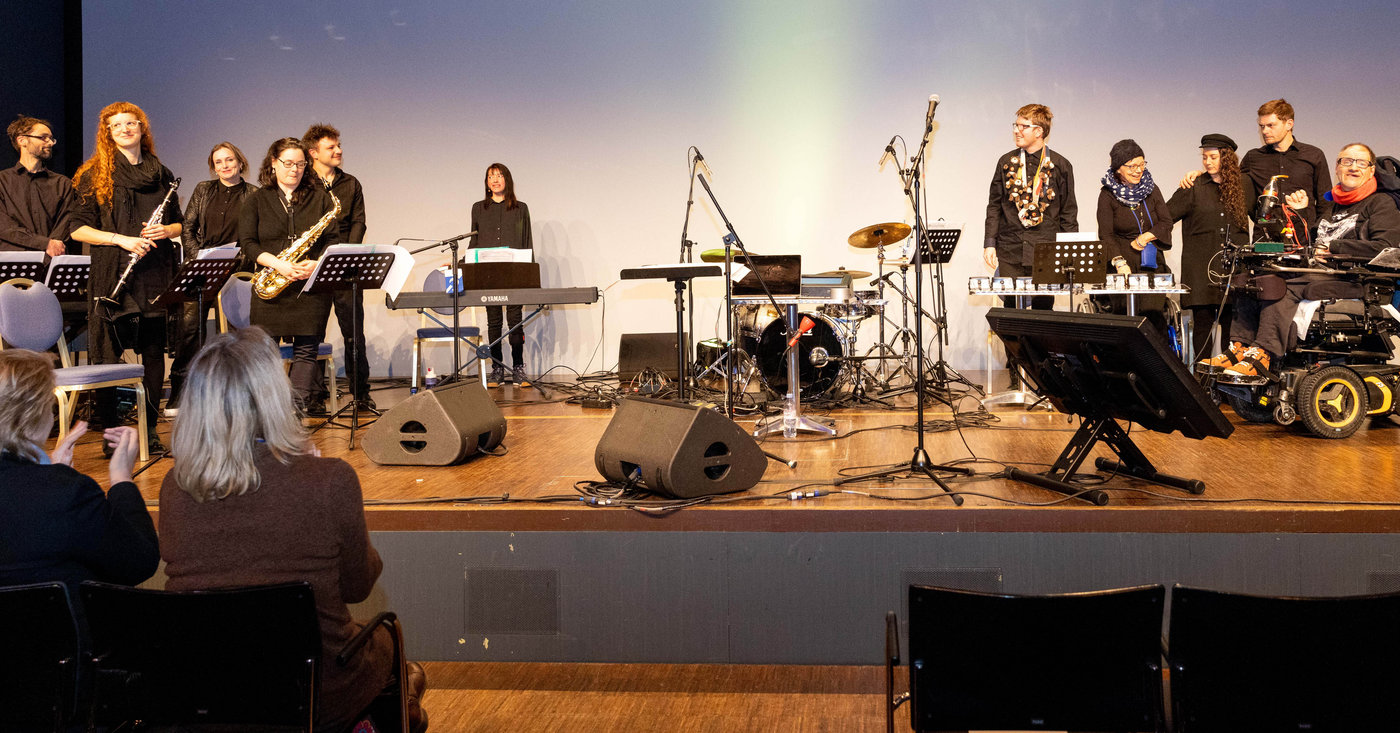
Founded in 2017, the Tabula Musica Orchestra is based in Bern. Photo: Anne Fröhlich FRAME PHOTOGRAPHY
Basel Composition Competition 2023
The fourth Basel Composition Competition will take place in Basel from February 9 to 12. There are 12 nominated compositions.
PM/SMZ
(translation: AI)
- 24 Jan 2023
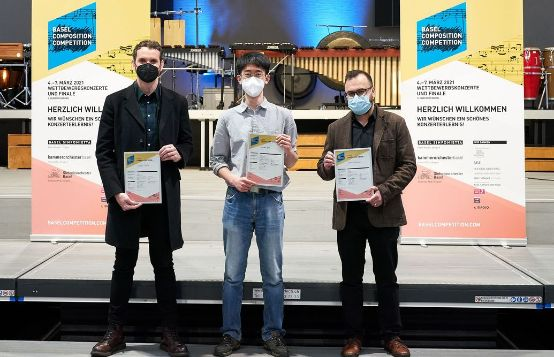
The three 2021 award winners. photo: Olivia Brown
The invitation to tender for the fourth Basel Composition Competition was open to all composers, there were no age restrictions or educational requirements. The three best compositions were awarded cash prizes (CHF 60,000 for first prize, CHF 25,000 for second prize and CHF 15,000 for third prize).
Only 14% of the submissions came from women. For this reason, the competition's education project aims to help create new role models. Since the first competition in 2017, there has also been another educational project that aims to familiarize schoolchildren with the profession of composing.
This year's jury consists of Michael Jarrell (President), Rebecca Saunders, Isabel Mundry, Andrea Scartazzini, Toshio Hosokawa and Florian Besthorn.
All concerts can be followed via a free live stream.
The concerts from February 9 to 11 will feature works by: Masato Kimura, Steven Heelein, Leonardo Silva, Jinhan Xiao, Carlos Satue, Kotaro Morikawa, Masashi Kawashima, Jinseok Choi, John Weeks, Valerio Rossi, Gijsbrecht Roijé, Nana Kamiyama.
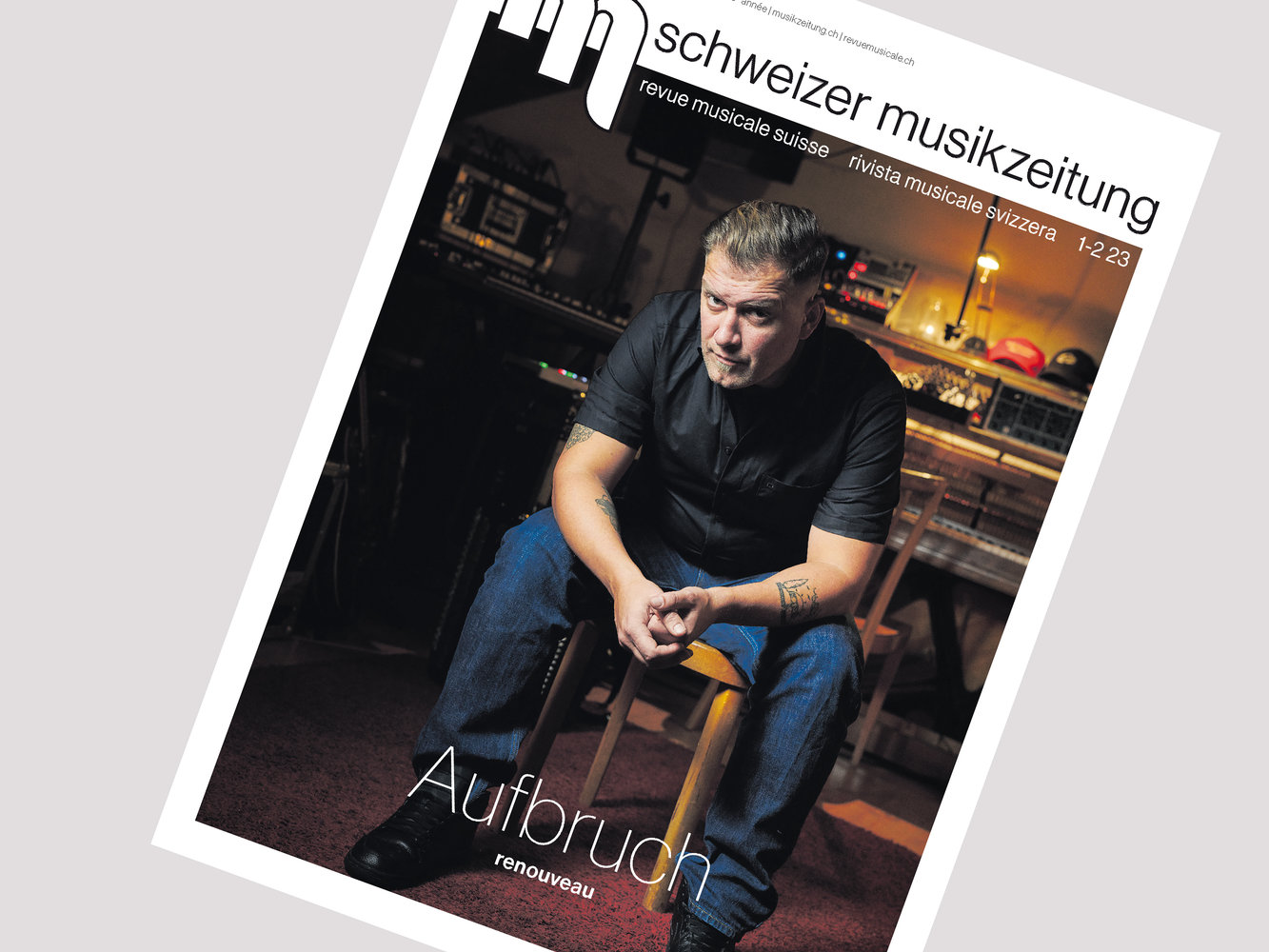
"Awakening" or "renouveau" in French is the theme of the first issue in Harriet Messing's redesign. The articles in this issue explore the constant departure into new realms, as well as the question of what role music can play in times of social upheaval. The cover photo by Holger Jacob shows Mario Batkovic.
SMZ
(translation: AI)
- 18 Jan 2023
Cover picture issue 1_2/2023
Table of contents
Focus
"I was broken into" - Interview with Mario Batkovic
The renewal of the guitar continues - current compositional and pedagogical trends
Breakout or departure? - Multimedia composing
Iran: Women sing for freedom - preserving cultural heritage despite performance ban
Music can be loud. Or quiet. But always insistent, please! - A plea for radical artistic answers to the questions of our time
(italics = summary in German of the original French article)
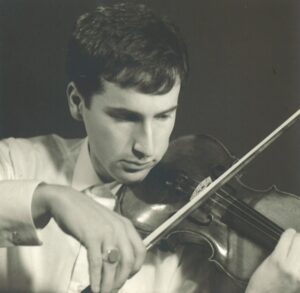
Urs Joseph Flury is not only known as a violinist and composer, he is something like the musical memory of the Swiss music scene of the 20th century.
Ulrich Lips
(translation: AI)
- 28. may 2021
Urs Joseph Flury 2011. photo: zVg
The main activity of Flury's father, the late Romantic composer Richard Flury (1896-1967), took place in the first half of the 20th century with countless contacts, and often friendships, with composers and performers from Switzerland and abroad. He maintained a lively exchange about these experiences with his son Urs Joseph, born in 1941, who in later years was present at many encounters himself; his encounter with Pablo Casals was particularly influential.
Flury's (excellent) memory therefore goes back a long way. And so it is that he knows details from the Swiss music scene extremely well: when did Scherchen leave the Winterthur orchestra, who of the orchestra musicians moved with him to Zurich? What were the (piquant) circumstances surrounding Max Reger's piano recital in Lausanne? How did the tragic relationship between Maria Schell (who was in and out of the Flury household) and the violinist Georg Kulenkampff develop? - Flury knows thousands of such details and recounts them on occasion. Flury is contacted from all sides with questions about this period. He has been asked countless times to write a book about it. Because apart from him - and after him - no one else will know.
Discoverer and preserver
Flury has always been fascinated and impressed by artists who have worked in several fields, "double talents" as he calls them. Among them are well-known names: E. T. A. Hoffmann, Jean-Jacques Rousseau or Emperor Joseph I of Habsburg. But who knew about the musical talents of Arthur Schnitzler, Annette von Droste-Hülshoff, the clown Grock, the freedom fighter and enlightener Tadeusz Kościuszko and many others before Flury dug up their works, performed them and recorded them on CD?
Through these discoveries, he saved countless works from being forgotten forever. He was particularly active in this respect with Solothurn composers: he edited and published works by Alois Glutz von Blotzheim, Casimir Meister, Edmund Wyss and Dino Ghisalberti, among others, whose catalog of works he compiled. In addition to his musical field, Flury secured the work of the Solothurn poet Olga Brand (1905-1973) with the publication of a volume of poetry in 2005.
He is particularly fond of his father's work, which is his true purpose in life. He has played and premiered countless pieces as a violinist, some of which are dedicated to him, and has orchestrated, conducted and recorded just as many on CD. With the establishment of the Richard Flury Foundation in 1996, he created the basis for the promotion of this work to be more broadly based and sustainable (www.richardflury.ch).
One of Flury's great passions is historical recordings, especially of violinists. He probably has the largest collection of recordings of the violinist Fritz Kreisler (also as a pianist!), but also of Jacques Thibaud, Aldo Ferraresi, Alfredo Campoli, Gabriella Lengyel and Georg Kulenkampff. Many labels owe him the publication of recordings. Flury has donated dozens of historical recordings to the Fonoteca nazionale in Lugano.
Composer, violinist and conductor
Urs Joseph Flury 1966. photo: zVg
Flury's œuvre (www.ujflury.ch) includes vocal and orchestral works, instrumental concertos and chamber music works in a wide variety of instrumentations. With the music to the fairy tale The little mermaid (1979), generations of Solothurn children have grown up with it and countless performances have taken place, with and without ballet. The sacred works set to texts by Beat Jäggi (Soledurn Wiehnechtsoratorium and Passion in Solothurn dialect) and, more recently, compositions commissioned by the Solothurn choir, The frozen people and Four songs for the annual cycle. He considers his best instrumental work to be the symphonic poem Vineta. Flury's cello concerto exists on CD with the soloist Pierre Fournier, the violin solo sonata with Ruggiero Ricci, the violin concerto in D with Alexandre Dubach. The Romantic piano concerto (with Margaret Singer) is a "perennial favorite" on Radio Swiss Classic. Many chamber music compositions are in print.
A pupil of Walter Kägi and Hansheinz Schneeberger, Flury was in demand as a soloist and chamber musician from the 1960s onwards. In 1966/67 he was concertmaster of the Camerata Biel and from 1965-1968 a member of the Basel Chamber Orchestra. He taught violin at the city schools in 1967 and at the cantonal school in Solothurn from 1968 to 1998. From 1967-1972 he was a violin and theory teacher at the Biel Conservatory.
He has conducted the Solothurn Chamber Orchestra since 1971 and also led the Orchestre du Foyer Moutier from 1970-2016. In his programs, he avoids the "big" works that every music lover knows well and that an amateur orchestra generally cannot really master. He prefers to focus on rarities by great masters or works by Solothurn composers, usually premieres and often orchestrated or arranged for the requirements of the orchestra.
Urs Joseph Flury was awarded the Art Prize of the Canton of Solothurn in 2016 for his extensive musical activities.
The Walter Furrer revival
Over the last six years, a number of works have been performed, CDs and a master's thesis have been produced. An article in the "Schweizer Musikzeitung" was the starting signal for the renewed interest in the composer, driven by Beatrice Wolf-Furrer.
Beatrice Wolf-Furrer
(translation: AI)
- Feb 25, 2021
In June 2012, out of a sense of duty, I donated the musical estate of my father, the Swiss composer Walter Furrer (1902-1978), to the Burgerbibliothek Bern as part of a donation agreement. His musical production had brought him occasional recognition during his lifetime, but never a breakthrough in the true sense of the word. Only two years after the donation, the task of reviving his works came to me as a matter of course.
The big question: How to start? I had been in possession of a copy of the autobiographical essay for some time My student years in Paris. I read it carefully for the first time, realized that it was well written and with its very own touch of Furrerian humor; what could be more obvious than to dedicate it to the Swiss Music Newspaper to offer! This led to the publication of a particularly tasty excerpt in November 2014. The essay as a whole was posted online. And it even brought me a few reactions from readers who were still familiar with Walter Furrer.
The Swiss Music Newspaper continued to support my work by publishing the interviews I conducted in 2015 with the following people who still knew Walter Furrer:
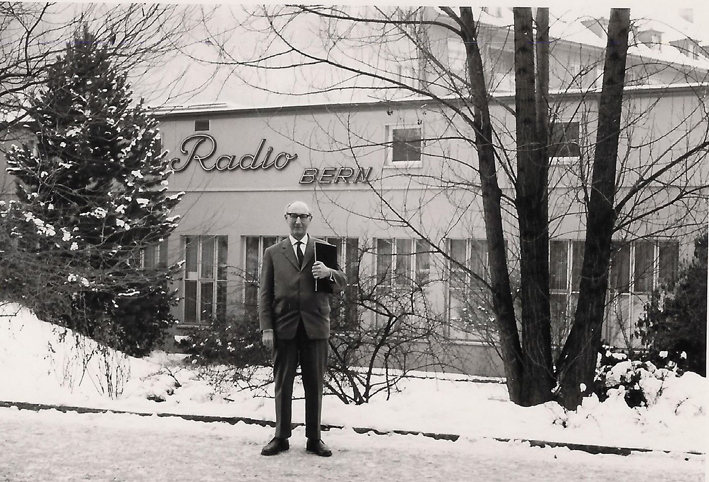
- with the Music expert Walter Kläy, who, like Klaus Cornell, was a young colleague of Walter Furrer's at Radio Studio Bern;
- with the widow of the Swiss clarinettist Antony Morf. Walter Furrer had dedicated his small composition Nahtegal, guot vogellîn dedicated.
A first step had been taken. What next?
"Turn to the universities of the arts," friends and acquaintances advised me. I did this throughout Switzerland - without success. But I was given the valuable tip to get in touch with the Bern Chamber Orchestra. That's how I got to know Beat Sieber, who was its managing director at the time (he is now the director of the Kammerphilharmonie Graubünden). After a short time - he had already had a look around the Burgerbibliothek - he informed me that the Bern Chamber Orchestra would be performing Walter Furrer's vocal cycle Six Turkish Songs for baritone and chamber orchestra (premiere in 1971 at the Centre de musique contemporaine et de premières auditions, Geneva) into his themed concerto Alla Turca.
The concert took place on May 21, 2017 at the Bern Conservatory under the direction of Philippe Bach, with the songs performed by mezzo-soprano Claude Eichenberger; the entire performance was recorded by Radio SRF 2 Kultur and broadcast on July 6, 2017.
The cycle Turkish songs was also lucky in the following period: on March 15, 2019, it was heard again in an anniversary concert of the Thurgau Chamber Orchestra in Kreuzlingen, conducted by the Swiss conductor Tobias Engeli, who works mainly in Germany. Once again, a singer, Barbara Hensinger, interpreted the songs. There is a web review of both the Bern and Kreuzlingen premieres by Biel music expert Daniel Andres (see homepage www.walter-furrer.ch).
The Förderverein Komponist Walter Furrer was founded back in 2015 with a minimal line-up of three people: Beat Sieber, Patrick Freudiger and myself. Nothing has changed in this form to date. Beat Sieber set up the aforementioned website, which he has managed ever since.
Shortly afterwards, I was visited by the clarinettist Andreas Ramseier, who works at the Burgdorf music school, among others; he also warmed to Walter Furrer's music and helped me to organize a first vocal concert, in which he himself was joined by the artists Barbara Hensinger (alto), Yvonne Friedli (soprano) and Barbara Jost (oboe) as well as the pianist Andres Joho. It was performed three times in Switzerland and twice in Germany from 2017 onwards; this also provided an opportunity to draw attention to the composer for the first time in Plauen in the Vogtland region, where he was born.
Musicology Institute of the University of Bern
In December 2016, Cristina Urchueguía held the edition philology seminar "Preserving the Swiss composer Walter Furrer from oblivion" at the Institute of Musicology at the University of Bern; two further works emerged from this seminar:
- Walter Furrer's small composition created in the seventies of the 20th century Nahtegal, guot vogellîn for chamber choir, viola, guitar, recorder and tambourine (text: Heinrich von Stretelingen, 1258-1294) was arranged for lute, flute, accordion and soprano by the lutenist Irina Döring and performed in this form five times in Switzerland by the Ensemble Lumières médiévales.
- Another participant, Tamara Ackermann, picked out the so-called "workers' songs" from the rich choral oeuvre, which would later become the subject of her Master's thesis.
2018 - the 40th anniversary of Walter Furrer's death - was a particularly rich year:
- On March 17 and 18, the Zürcher Sing-Akademie under the direction of Florian Helgath performed Walter Furrer's composition, which was commissioned by the Berner Stadttheater and printed by the Zurich music publisher Hug Three religious choruses from Faust I (Goethe; Mater dolorosa, Dies irae, Chorus ad diem festi paschae). The production, which was staged on February 22, 1944 by Faust I premiered choirs were not given enough attention at the time and have only now received their full appreciation (see homepage).
- On June 19/20, 2018, there was a studio recording on SRF 2 Kultur, which I owe to the music producer Norbert Graf and the fact that Beat Lüthi, then head of the Bern-based music publisher Müller & Schade AG, agreed to a co-production. Parts from the aforementioned first vocal concerto were recorded, as well as Lieschen's dirge from Walter Furrer's opera, which premiered at the Stadttheater Bern in 1947 The faun (Performers: Yvonne Friedli, Andres Joho).
The concert ended with a recording of the above choirs from Faust Iwhich the Zürcher Sing-Akademie generously made available for this commemorative CD. It thus provides an insight into three key areas of Furrer's oeuvre: lieder, opera and choral composition. It was released in late fall 2018 - together with the book Walter Furrer (1902-1978), an unjustly forgotten Swiss composer. A biographical outline by Beatrice Wolf-Furrer - published by Müller & Schade AG. In the same year, SRF 2 Kultur broadcast part of the vocal cycles under the title "Unjustly forgotten?", together with works by other, equally forgotten composers.
- At the end of August, Tamara Ackermann submitted her Master's thesis at the University of Basel. Vision - The compositional ideas of the Swiss Workers' Singers' Association using the example of the workers' songs by Walter Furrer (1902-1978) before. These choruses were requested by the Swiss Workers' Singers' Association at the time and most of them were also published. The work will be printed by the Musikforschende Gesellschaft der Schweiz in 2021.
- The first resounding success in Germany took place on October 10 and 12, 2018 in Reichenbach (Neuberinhaus) and Greiz (Stadthalle): The Vogtland Philharmonic Orchestra under the direction of Dorian Keilhack performed Walter Furrer's Scherzo drolatiquethe second opera, written in 1949/52 and never performed before Dwarf nose (based on the fairy tale by Wilhelm Hauff): it is a concert arrangement of the Kitchen Boy Ballet from the 4th picture, created in 1955, which was broadcast several times by Swiss radio stations in the 20th century and was also performed publicly in Aachen in 1973.
- On October 12, 2018 - at the same time as the concert by the Vogtland Philharmonic Orchestra in Greiz - the vocal concert was performed for the fifth and final time at the Schwartzsche Villa in Berlin-Steglitz.
But there is also a lot to report about Walter Furrer in 2019 and even 2020. First of all, a well-attended soiree was held at the Burgerbibliothek Bern on June 6, 2019: In the first part, I reported on the activities to date, in the second Tamara Ackermann explained the key points of her Master's thesis and in the third Andreas Barblan provided information about Furrer's archives using examples.
In the first half of 2019, I got to know the organist Matthias Wamser. He works as an organist mainly at St. Anthony's Church in Basel, conducts several choirs, publishes musicological texts and actively promotes forgotten composers of the 19th and 20th centuries. Walter Furrer's sacred compositions - there are, if one counts Three religious choruses from Faust I not among them, only three, which nevertheless occupy a significant place in his oeuvre - appealed to him spontaneously, although initially it was only the 1973 Le chiese di Assisi. Nove visioni musicali per organo went. D
hrough repeated visits to the Umbrian town of Assisi, the composer became increasingly familiar with its nine churches and was increasingly captivated by Franciscan spirituality. On October 13, 2019, 46 years after the world premiere in the Cathédrale de Lausanne, the Chiese in St. Anthony's Church in Basel: Matthias Wamser included it in the concert "Organ music on the way to Francis of Assisi" with works by César Franck, Charles Tournemire, Franz Liszt and Hermann Suter. On July 9, 2020, he played it again as part of the Plauen Organ Summer in the monumental St. Johanniskirche, directed by Heiko Brosig.
In the meantime, Matthias Wamser had also worked on the two psalms, and so the three sacred works were recorded in Basel's Antoniuskirche on November 22, 2020: the Chiese di Assisithe Psalm 102 and 27 for alto, oboe and organ and of Psalm 142 for soprano and organ (Performers: Barbara Hensinger, alto; Chelsea Zurflüh, soprano; Matthias Arter, oboe; Matthias Wamser, organ; Gerald Hahnefeld, sound recording, editing and mastering; Beatrice Wolf-Furrer, production & copyright). The CD was released at the end of January 2021 and can be ordered from me via marnac@besonet.ch for the price of 20 francs.
Concerts
In 2019, I organized a second vocal concert, this time independently. It included four cycles (Sechs türkische Lieder für Bariton und Klavier, Sieben Lieder für Sopran und Klavier, Six fables de Lafontaine pour baryton et piano, Sources du vent. Sept mélodies pour soprano et piano), three of which are originally accompanied by chamber orchestra, individual instruments or large orchestra and only one of which was originally written for voice and piano. However, the composer arranged piano versions for all three with small halls in mind, in order to make them known more quickly. The two cycles based on texts by French authors were important to me so that I could point out his affinity with the French language and culture: Walter Furrer's two years of counterpoint lessons with Nadia Boulanger at the Ecole normale de musique in Paris in the 1920s determined the development of his compositional style once and for all.
This second vocal concert premiered on October 6 in Basel's Schmiedensaal (performers: Delia Haag, soprano; Benjamin Widmer, baritone; Tomasz Domanski, piano). This was followed by further performances on November 6, 2019 in Biel's Farelsaal (recording by the Gerald Hahnefeld recording studio) and on March 15, 2020 in Kirchlindach (Reformed Church; Walter Furrer is buried in the cemetery there). The soprano part has since been taken over by Chelsea Zurflüh, a young singer from Biel.
And then corona hit us all, and the next two concerts on March 22 and May 26, 2020 were banned. I spent weeks negotiating new dates and venues - for nothing! Until I finally managed to "complete" the two events under strict conditions (limited audience numbers, compulsory masks) on November 1 at the Langenthaler Bären and on December 5, 2020 at the Bern Conservatory. With flying colors, by the way! The hand-picked specialist audience thanked the artistic crew.
The year 2021 will primarily be dedicated to the following projects:
- the aforementioned publication of Tamara Ackermann's master's thesis;
- the production of advertising material for the opera Dwarf nose. At the same time, a concert performance of a cross-section of the opera (with piano accompaniment) is being rehearsed. The purpose of both is to interest theaters in Switzerland and Germany in the work. It is being considered to perform the aforementioned performance as a dramatic vocal concert if possible;
- the publication of a supplementary volume to my Biographical outline. This publication will only contain source texts such as Walter Furrer's statements about his compositions, his unabridged autobiographical essay My student years in Parisbut also correspondence, insofar as it concerns the compositional work, etc. The Bern-based music publisher Müller & Schade AG - now managed by Urs Ruprecht - publishes the volume.
Hubert Harry: Gifted teacher and phenomenal performer
As a teacher, he created an "Isle joyeuse" at the Lucerne Conservatory; as a performer, he set binding standards in his concerts: memories of Hubert Harry, who died on June 12, 2010.
Patrizio Mazzola
(translation: AI)
- 23 Jun 2020
Hubert Harry. Photo: hubertharry.com
Born and raised in the English region of Cumbria, where his mother was a singer and his father an organist and choirmaster, Hubert Harry began playing the piano at the age of two and a half and performed Rachmaninov's famous Prelude in C sharp minor at the age of four. As a teenager, Hubert was entrusted with various important musical tasks in his native England until he came to Switzerland at the age of just 19 to study with the famous pianist Edwin Fischer. The latter ran a master class at the Lucerne Conservatory, which had only been in existence for four years at the time (founded in 1942, during the war, by the Lucerne lawyer and music connoisseur Walter Strebi, among others). In Lucerne and on Lake Lucerne in Weggis/Hertenstein, Hubert Harry was able to meet Rachmaninov's widow, which was a particular honor and pleasure for him as a great admirer of this composer.
Educator
Thanks to Harry's life in Lucerne and his contact with the conservatory there, he became a teacher himself at this institute just a few years later, to which he would remain loyal for decades. Countless piano students (including myself) went through Harry's school, which over time began to radiate beyond Lucerne. In his class, you felt so much at home musically and personally that when you left this "Isle joyeuse", you first had to get used to the rest of mundane life again. His wife, Heidi Harry, also an excellent pianist, also made a significant pedagogical contribution, for example by supervising the methodology courses. (She was also a teacher of the pianist-trained Federal Councillor Sommaruga).
Performer
Although the main focus of Hubert Harry's musical activity was teaching, there were occasional major concert events, preferably in Switzerland. The rarity of these concerts made them special highlights, often even great moments. Fortunately, many of them are documented and accessible in successful recordings. Harry's programs were mainly devoted to the great international concert literature. However, his interpretations of the much-played literature have never had to shy away from comparison with (so-called) world-famous pianistic greats - in fact, the opposite is the case ... With individual performances, Harry succeeded in setting binding standards that have hardly been equaled, let alone surpassed.
Effect
This may come as a surprise, given that Harry's work remained so limited and never achieved the broad impact it deserved - probably also because this was not a concern for Harry in his genuine humility and dedication to music. But true great art is very often hardly recognized as such at first and only appreciated posthumously (in which Harry is admittedly in good company). It remains to be seen whether Harry's deserved world fame, if it were important to him, will come to pass. With today's technical and digital possibilities, it is conceivable. Until then, his growing circle of followers will remain a privileged community of insiders.
Current
On Saturday, July 4, 11 a.m. to 4 p.m., the Lucerne School of Music will be holding an event at Dreilinden to bid farewell to its current location before moving to the new building at Südpol Luzern/Kriens. Patrizio Mazzola will play and comment on works in memory of Hubert Harry and Caspar Diethelm, who both worked at the school for a very long time.
Ingvar Lidholm, one of the greatest Swedish composers of the 20th century, died on October 17, 2017 at the age of 96. He was not only one of the most important figures of the Swedish "choral miracle", but there are also points of contact with Switzerland.
Markus Utz
(translation: AI)
- Nov 10, 2017
The composer Ingvar Lidholm is particularly well known in choral circles in this country. He was a member of the Monday Group, which paved the way for the so-called Swedish choral miracle. The group also found inspiration in Basel.
Ingvar Lidholm, one of the greatest Swedish composers of the 20th century, died on October 17, 2017 at the age of 96. Following the deaths of Knut Nystedt (1915-2014) and Einojuhani Rautavaara (1928-2016), Lidholm is another highly significant Scandinavian composer of the 20th century.
Lidholm was a central figure in Swedish musical life for over 70 years and wrote groundbreaking works for choir, chamber music and orchestra. His work contributed significantly to the so-called "Swedish choral miracle", the emergence and movement of choirs capable of performing very difficult pieces. These pieces include Laudiwhich Lidholm composed at the age of 26, inspired by a choir conducted by his friend Eric Ericson. "Almost impossible to perform", was allegedly the verdict of the choir members when they got their hands on the sheet music in 1947.
Lidholm wrote a cappella works, solo works for clarinet, oboe and violoncello, but also orchestral works such as Contacion (1978) and Ritornello (1955) and operas like The Dutchmanfor which he received the Salzburg Opera Prize in1968, or A dream game (Ett drömspel, 1990). Other compositions by Lidholm have since become classics in the choral world, such as Canto LXXXI (1961), Libera me (1995) and a riveder le stelle (1973).
(For a detailed biography and list of choral works, see below).
The Monday group
A number of Swedish composers, musicians and musicologists got together in 1944 and met regularly on Mondays until around 1950 to discuss composition. The informal leader of the group was Karl-Birger Blomdahl (1916-68). The meetings took place in his family's apartment on Drottninggatan in Stockholm, with coffee provided by his mother.
As international contacts had been broken off due to the Second World War, there was a great need to exchange experiences. Among other things, they discussed the theory of movement and form with composers such as Hindemith, Bartók, Stravinsky, Schönberg and Berg. The core of the group consisted of Blomdahl himself, Klas-Thure Allgén, Sven-Erik Bäck, Sven-Eric Johansson, Hans Leygraf, Claude Génetay, Eric Ericson and Ingmar Bengtsson, as well as Ingvar Lidholm.
In 1946, several members of the group (Sven-Eric Bäck, Eric Ericson and Lars Edlund) traveled to Basel to the "Teaching and Research Institute" for Early Music to study with Ina Lohr. As Paul Sacher's assistant, Ina Lohr played an important role in establishing the institution now known as the Schola Cantorum Basiliensis. All her work was underpinned by a deep religiousness. She was involved in the Swiss singing movement and in the introduction of the rehearsal volume of the new church hymnal. At the same time, the early music movement was gradually seeking greater professionalization, wanting to free itself from the label of dilettantism that substantially defined house music, which contributed, among other things, to the fact that Ina Lohr's name is hardly known today.
When the Monday group started meeting again in 1947, several new participants joined, including Göte Carlid, Magnus Enhörning, Nils L. Wallin and Bo Wallner.
Paradigm shift in musical life
The orientation of the Montagsgruppe was, and became over time, more and more radically modernist music. The original aim was to improve their own compositions in parallel with the development of European art music. But they also wanted to work towards gaining more understanding for their own, often mocked music. In Sweden, they had to fight against the traditionalist music establishment, in which late romanticism and neoclassicism were the predominant stylistic ideals. The distancing from late Romanticism also included an interest in Baroque music and its performance practice among many members of the group.
The members of the Montagsgruppe took an active part in the debates on new music, gradually gaining more attention and more influence. And so gradually (after the group had already disbanded) some of its members, first and foremost Blomdahl, Bäck and Lidholm, occupied central positions within the Swedish music scene. The Monday Group is therefore of central importance in the Swedish music history of the 20th century and responsible for the clear aesthetic and stylistic paradigm shift in musical life during the 1950s and 1960s. Both Blomdahl and Lidholm became professors of composition at the Royal College of Music in Stockholm. Choral music in particular made a decisive contribution to the general development of new music in Sweden after the Second World War.
The enormous development of contemporary Scandinavian choral music itself, which is also known as the "Swedish choral miracle", is primarily linked to the choral conducting legend Eric Ericson. He not only inspired composers to write such new works. Above all, he also trained choral conductors who were no longer "afraid" of new sounds and unusual scores. In this way, he set a cycle in motion for subsequent generations in which capable choirs, excellently trained conductors and composers were able to fertilize each other.
Today, this influence is seen as both positive and negative. Other composers who did not share the group's ideals or who composed in a more traditional way were largely ignored by institutions such as Swedish radio, led by members of the Monday Group or their friends and "allies". This was described by composer Erland von Koch, among others, in his book Music and songs [Music and Memories], Stockholm 1989.
Born in Jönköping, in the southern Swedish province of Småland, on February 24, 1921, he studied violin with Hermann Gramms and orchestration with Natanael Berg as a high school graduate in Södertälje. From 1940 to 1945 he studied violin with Axel Runnqvist and conducting with Tor Mann at the Royal College of Music in Stockholm; from 1943 to 1945 he also studied composition with Hilding Rosenberg. He was a viola player at the Stockholm Opera from 1943 to 1947.
The prize of the Jenny Lind Fellowship enabled him to continue his studies in France, Switzerland and Italy. He was music director of the city of Örebro (1947-1956) and the first Swede to take part in the Darmstadt International Summer Course for New Music in 1949. In 1956 he became program director for chamber music at Swedish Radio. From 1965 he taught composition at the Royal College of Music in Stockholm, returning to the radio in 1975 as planning director for new music. From 1967 he was also editor of the journal New music. Vrom 1947 to 1951 and from 1963 to 1965 he was a member of the board of the Swedish Composers' Society. He was also Vice-President of the Royal College of Music in Stockholm from 1963 to 69 and a member of the board of the International Swedish Composers' Association.
He was awarded the Christ-Johnson Prize in 1958 and the International Koussevitzki Prize in 1965. In 1968, he was awarded the Salzburg Opera Prize for his composition The Dutchman excellent. He himself said about his composing: "I always try to keep in mind that my job is to make music speak ... Let's try to formulate music again that speaks strongly and directly to the listener, music for people of our time."
Ingvar Lidholm's early works reveal a subjective, Scandinavian romanticism (Gullberg chants 1944), even before long elements such as those of Hindemith or Bartók come into play (Concerto 1945, Music for strings 1952). The choral composition Laudi combines early vocal polyphony with modern harmony. Lidholm's musical language is rich and varied, the number of his works remarkable and his style versatile.
The international breakthrough came with the orchestral piece Ritornello. Vhis other pieces for orchestra, especially the ballet Riter (1959), Mutanza and above all Poesis (1964 for the 50th anniversary of the Stockholm Philharmonic Orchestra) should be mentioned. The latter is an unconventional piece for an anniversary, with brutal, differently colored blocks of sound, dynamic culmination points and absurd solo cadenzas for piano and double bass. Greetings from an old world was composed in 1976 for the Clarion Music Society of New York on the occasion of the bicentennial of the United States of America.
"I make use of tradition - with clearly understandable sound models with a gestural, virtuoso or melodic character." An important ingredient of the piece is Heinrich Isaac's Wanderlied Innsbruck, I have to let you go. The matching sister plant is Contacion (1979), which was composed on the occasion of a tour of the Soviet Union and incorporates Orthodox traditions in its sound. Probably no work of his has been more widely disseminated than Stamp Music. He wrote it in connection with the creation of a stamp to mark the bicentenary of the Royal College of Music in Stockholm.
List of choral works
Laudi (1947) Four choirs (1953) Two songs (1945-1955): 1st Saga (male choir) 2nd Jungfrulin (female choir) Canto LXXXI (1956) Motto (1959) Two Greek epigrams (1959). 1st Kort är rosornas tid (3-part male choir), 2nd Phrasikleia (soprano solo and female choir) Three Strindbergweisen (1959): 1st Välkommen åter snälla sol 2nd Sommerafton 3rd Ballad Nausicaa alone (1963): Scene for solo soprano, choir and orchestra a riveder le stelle (1971) The Persians (1978): Dramatic scene for recitation and large male choir Skaldens natt (1958/1981): For soprano solo, choir and orchestra De profundis (1983)
from the opera Ett drömspel (A dream game): Vindarnas klagan (1981), Troget och milt (1990) Inbillningens värld for male choir (1990/1996) Libera me (1993-94)
from the opera Ett drömspel (A dream play): Vocal symphony (1997), Two madrigals (1981) both with orchestra Madonnan's vaggvisa for solo voice and mixed choir (1943/2001) Grekisk gravrelief (2003)
Characteristics, style and meaning explained using two sonatas.
Bernhard Billeter
(translation: AI)
- Nov 09, 2017
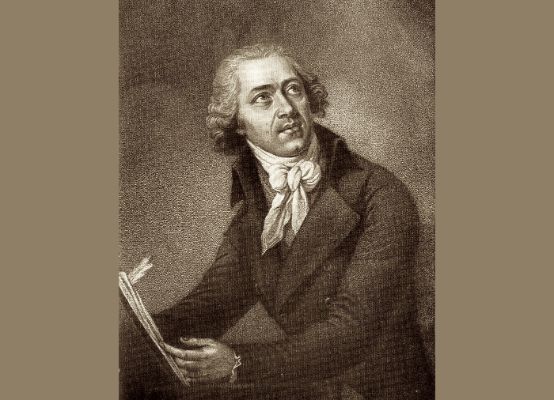
Portrait of Leopold Koželuch by W. Ridley. Source: Wikimedia commons
Even seven of the earliest manuscript sonatas that have survived and therefore cannot be dated - in volume IV of the new edition no. 44-50, probably before 1773 - are clearly not intended for harpsichord, but were written for the "fortepiano", which was on the rise at the time. They can compete with early Haydn sonatas in terms of inventiveness and depth of emotion. One of them in E flat major, No. 47, still has a two-part sonata form (without development) in the first movement, Adagio, as in Mozart's E flat major Sonata K. 282. Mozart probably composed it at the beginning of 1775 in Munich during the premiere of the dramma giocoso ordered there La finta giardiniera and the influence of Koželuch can probably be ruled out. This is a remnant of the early classical period.
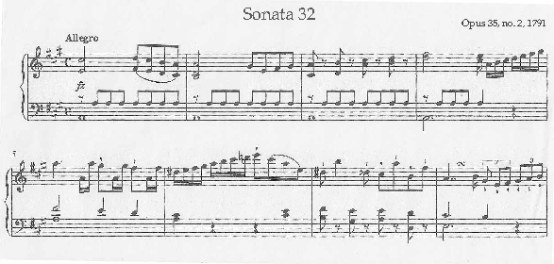
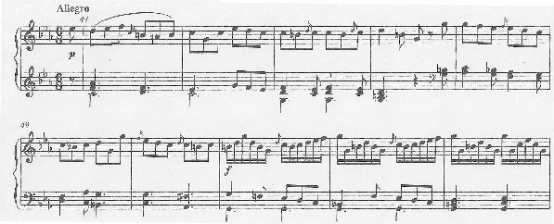
Two mature, large sonatas from the middle creative period deserve to be described in more detail. The one in A major op. 35 no. 2 from 1791 is in three movements and, like most, consists of a sonata form, a composite song form and a rondo form. The Music example 1 shows the prelude to the main theme in the form of the period; the postlude is extended to 12 bars.
Music example 1
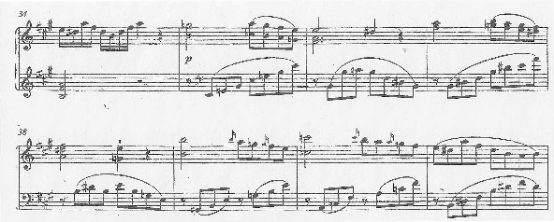
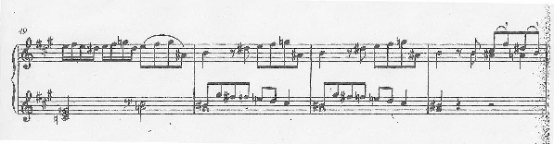
After the gradual transition to the dominant key, the dominant seventh chord remains for four bars. Here (Music example 2) at bar 35 could therefore be the beginning of the secondary movement. Surprisingly, the opening motif of the main theme appears in E minor instead of E major.
Music example 2
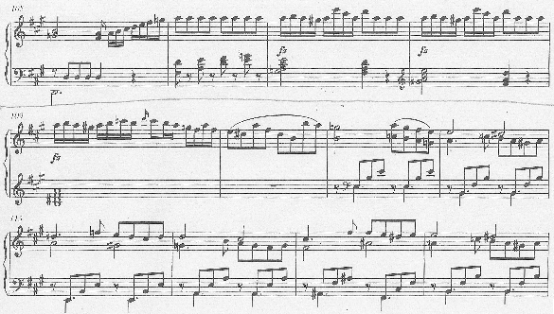
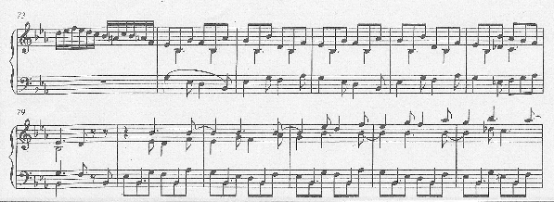
The Music example 3 in bar 49 shows a fallacy and the augmented sixth chord to the dominant and in the prelude to bar 53 the beginning of the relatively short (26 bars) secondary movement. In any case, we can only speak of a "final group", which is often bandied about in some form studies, in Beethoven's music. In the development section, the composer uses a wide range of motifs from the main movement. Four complete bars of the opening in D major could mislead the listener into hearing a reprise beginning.
Music example 3
In bars 111-117, the two-part complementary guidance of the right hand (Note example 4).
Note example 4
Instead of preparing the recapitulation with a longer pause on the dominant, Koželuch uses a much more drastic means, namely a one-bar general pause. We leave the remarkable comparison between exposition and recapitulation with shortened main movement and lengthened subordinate clause and numerous differences in detail to the intuition of an inclined reader, should they obtain the notes. It is worth it!
The end of this movement deserves a small comment: Here the repeat signs, which were otherwise common in early classical and mostly in classical sonatas for repeating the development and recapitulation, are also missing in Mozart. Koželuch breaks with this tradition here and in all subsequent piano sonatas. We will come back to this. - It will be easier to describe the remaining two movements, both with a miniature section in the middle and both of sparkling ingenuity. The expressive Adagio is revealed when the precisely written ornaments (called "arbitrary changes" in the 18th century as opposed to "essential manners") are recognized as such. The Rondo offers much more than simply a finale. Its main theme - or let's say more expertly: - its refrain only appears three times, the second time very abbreviated, but also as the framework of the Minore and therefore never seems trite. Because the Allegro of the first movement at times approaches an allebreve meter and the Allegro of the rondo is notated in two-four time, the former should be taken briskly and the latter somewhat more slowly. The audience will be amazed at the dazzling virtuosity of the performance, even if the level of difficulty is quite accessible to a skilled amateur (around level 8-9 according to Klaus Wolters) due to the piano practitioner's hand-crafted notation.
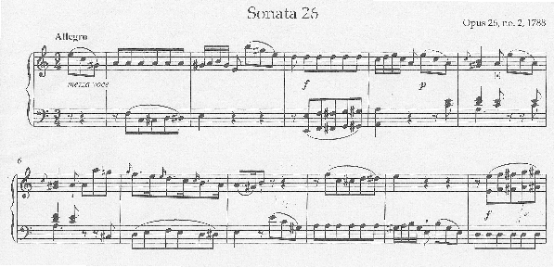
Five sonatas in the first two volumes and six in volumes III and IV begin with a movement in a minor key. As with Mozart, this is a small minority, but one that deserves special attention. Koželuch experiments with polyphonic elements in them, for example at the beginning of the Sonata op. 26 no. 2 in A minor from 1788 (Note example 5).
Note example 5
The secondary movement begins quite normally with a twelve-bar theme in the parallel key of C major. But when the same theme appears in E flat major without any modulation after a general pause of almost two bars, the surprise is perfect. Schubert sends his regards. Incidentally, the general pause requires a brisk allegro tempo.
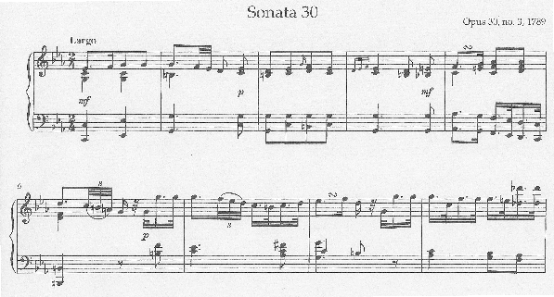
The Sonata op. 30 no. 3 in C minor from 1789 is even more interesting, also in its unusual sequence of movements. It begins with an extensive slow movement section, far too extensive for an introduction, even if it remains unfinished on the dominant.
Note example 6
The first 8 bars (Note example 6) look like the prelude to a period. The dotted semiquavers with thirty-second notes evoke a funeral march.
Note example 7
Attacca begins the Allegro in sonata form. Here too, the beginning, i.e. the main movement theme (Note example 7) a preceding movement. It is extended to 14 bars by repeating the half-finale. Instead of a final movement, there is a transition section to the major parallel with only 16 bars. The secondary movement (Note example 8) is extremely short at 36 bars compared to other sonatas by Koželuch and his contemporaries.
Note example 8
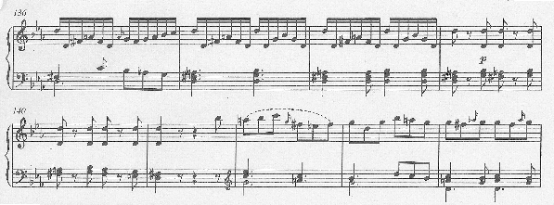
As usual, the repeat sign appears at the end of the exposition. But where should the repeat begin, with the Largo or the Allegro? The composer does not specify this, because it goes without saying: with the Allegro! The development section would again be very short at 32 bars. But does the recapitulation really begin here in bar 142, in the key of G minor? No, as in the A major sonata, it is a mock recapitulation. (Note example 9).
Note example 9
The "correction" to C minor (Note example 10). Schubert goes much further: in the two piano sonatas in A minor and C major ("Reliquie"), written almost simultaneously, he deliberately completely obscures the beginning of the recapitulation, which music theorists may well argue about. With Schubert, it is a departure for new shores. Should we allow Koželuch to do the same on a more modest scale?
Note example 10
Koželuch breaks with another tradition already mentioned above at the end of the recapitulation, namely the repetition of the development section plus recapitulation. This would not be possible because the Allegro and the Largo which concludes the movement are inextricably linked. This can be seen particularly clearly on the facsimile page of the first edition reproduced in the Bärenreiter edition, i.e. the only source: there is no double bar line, only the new bar mark 2/4. But even without the facsimile page, the interlocking is clearly evident: the opening chord of the Largo forms the conclusion of the cadenza at the end of the Allegro. This raises the question of whether Koželuch was inspired by this C minor sonata, which was composed two years before the A major sonata discussed above, to reconsider the second repetition of a sonata form. This is a hotly disputed question in performance practice. Mozart dispenses with the second repeat in sonata forms, albeit rarely.
Let's digress for a moment: in Mozart's piano sonatas, this only applies to his last two, K. 570 in B flat major and 576 in D major. However, the source situation for the B flat major sonata is unfavorable, but the case is clear. There is only one sonata for piano and violin: K. 481 in E flat major, none of the piano trios and one of the string quartets: K. 575 in D major. This means that Mozart used them deliberately. So they can actually be played where Mozart wrote them. Unfortunately, however, they are rarely heard in piano and chamber music recitals or on recordings, even by prominent performers. Koželuch, in contrast to Mozart, consistently stuck to this decision until the end of his life.
The second movement of the two-movement sonata begins attacca again, a rondo in liberating C major. The refrain appears once in G major in a strongly altered form and once in C minor as a brief reminder of the first movement.
All in all, Koželuch's work is not only worthwhile for pianists, but also as an interesting collection of examples for the subject of form theory, namely the subject that unites all other subjects of so-called music theory and is suitable for bridging the gap between theory and interpretation practice.
Hanspeter Künzler (translation AI)
(translation: AI)
- 30. Mar 2017
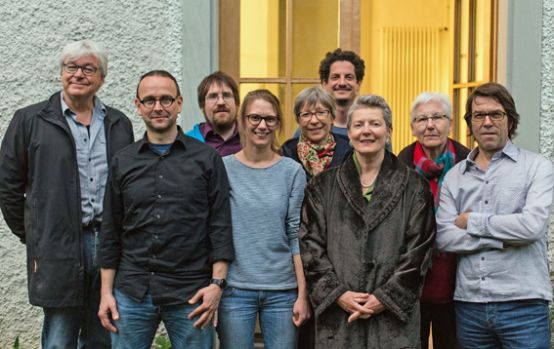
The Intakt team 2016 with Patrik Landolt, outside left. Photo: Michelle Ettlin
Could you please start by giving us a brief outline of the history of Intakt Records get? Patrik Landolt: You can start like this: in 1984, I co-organized the Taktlos Festival together with Bern. There was a focus on Irène Schweizer with international guests such as Joëlle Léandre, Maggie Nicols, George Lewis from New York, Günter "Baby" Sommer from Dresden. It was a free festival, and Radio DRS recorded everything for three days. So we had the tapes from the festival. We thought it would be best to make a record around Irène. Because Irène was very under-documented back then. She had released stuff on FMP, but some of it wasn't even available in Switzerland. So we made the record, Irène live at Taktlosmore because nobody else wanted the tapes. That was the beginning. The second record came relatively quickly. That was also an international affair with the entire London Jazz Composers Orchestra with Anthony Braxton.
Why did such people have their record published by an amateur in Zurich?
It was always the case that the free creative music world was not published by the big multinationals. One multinational documented the loft scene in New York with a series in the 1970s. It was called Wild Flowers. They thought it would be big business and it was THE flop. They didn't sell more than a few hundred of the boxes. That was one of the historic moments when big business said goodbye to jazz. They realized they couldn't make any money with it. Today it's clear that the three remaining majors have largely said goodbye to this music. What they don't do at all is develop new artists. This task has always fallen to small independents. Maybe that's why we looked particularly trustworthy! It was amazing, first album Irène, second album with LJCO with Braxton and so on, it was a great thing.
You weren't a rock fan?
That was me too. It wasn't mutually exclusive. I was a total fan of King Crimson. But I was already intensively involved with jazz at grammar school. Miles, Coltrane, Roland Kirk. I was 15, 16 years old then. The Roland Kirk album with Beatles covers - incredible!
If I remember correctly, you ran Intakt as a hobby for a long time, didn't you?
Exactly, as a hobby that became more and more widespread. In the early days, I worked as a freelance journalist for the Tagi, radio and various newspapers. Then I was editor at the WoZ for 20 years, also on the management board. That took a bit of energy away from organizing festivals. After 10 years at Taktlos, I left there.
Everything was at your house for a long time. All those records were sitting around in your apartment.
Intakt was in the basement for the first few years. I was young, had no money and therefore no stock. You had to learn and discover everything yourself first. Everything was trial and error. We took a very Swiss approach - not getting into debt, very small steps, a slow but steady build-up. Slowly, we developed a back catalog, and a certain aesthetic direction emerged. The diversity and richness came about through a long process, not through a business plan. Today, you would learn how to design a business plan at a university. For us, it all started from a huge passion. That has remained to this day. Everything else had to be worked out with Swiss solidity. We took accounting courses and so on at the Migros evening school so that we could understand and read a balance sheet. We also had a very good accountant right from the start, who worked at the highest level. That is also one of our strengths. The whole back office is very solid. Musicians' accounts have to be transparent. That's an important criterion. It's very unusual in the business.
If you've worked all this out yourself, you've certainly had to learn the hard way. Can you remember any early mistakes?
The very first panel is upside down in the frame. We glued it incorrectly. Of course, you always have to learn the hard way. Most of the mistakes were made out of euphoria, sometimes because you made too many copies out of the feeling that "this board is so incredibly good, everyone wants to buy it". But you learn that you can't always transfer euphoria to market conditions.
Is it even possible to plan a reception?
You can't plan a lot of things. That was also an important experience. Especially in the music business, there is a lot of contingency and randomness. Which I think is a positive thing. You can't plan success. Even the big ones can't - almost not.
How big were the constraints at the beginning?
I think we made 2000 of the first one at the beginning, which was still vinyl. It's easier with CD. You usually make between 1,000 and 2,000 copies and then print more. Then you can reprint in installments. With the printed matter you can do it in increments of 1000, with CDs in increments of 300. That way you can keep reprinting. In the city, storage is unaffordable.
Irène Schweizer is the strong backbone of Intakt?
She was there from the very beginning, yes. We have followed her biography and her life over the years. We also live in the same city. I also think it's important that all three of us are rooted here. That's why we often work with artists from here. Pierre Favre. Lucas Niggli joined us even earlier than Pierre. We also try to be in contact with young people. That's something very important, a huge challenge. You're constantly on the move. You have to deal with new things all the time.
To what extent is this challenge linked to the rapid development of technology?
It's definitely the case that the technology alone forces you to stay on the ball. If you think about what has happened in music in the last 30 years! From vinyl to CD to downloads, then downloads in MP3 quality, followed by CD quality and now even hi-fi quality. The technological development alone forces you to be incredibly alert and to engage with things.
How big is the share of streaming in Intakt's sales? I could imagine that the Intakt audience is a classic case of an audience that still wants to have something in their hands.
Yes, but it all runs in parallel. In America alone, I think we have 70,000 to 80,000 sales contacts, and that includes streams. In the USA, our distribution runs via Naxos and Naxos Archive. You can use this if you pay a monthly fee. If someone listens to something of ours, it is also registered as a contact. On the other hand, we have also undergone a generational change in terms of our catalog in recent years. We now publish many much younger artists, including those from border-crossing areas on the fringes of rock and electronic music.
Is Intakt's roots in Zurich also responsible for its strength?
Yes, this music has perhaps been cultivated a little more here. That also has a disadvantage. Others think they don't have to do anything anymore because we do it.
Does the scene have its regulars?
The Rote Fabrik did this for years. The Unerhört Festival, in which Intakt is involved, takes place in various locations, such as the Theater am Neumarkt or the Rietberg. We also organize concerts in retirement homes and various schools. Some of the older students are very well informed, they have high expectations, so you can't just send a student from the jazz school! It's the same at grammar schools. We bring the best there. They notice immediately if something is wrong.
How many young music fans attend these events?
At Stadelhofen, 300 to 500 people come, depending on the teachers. It's up to them, but sometimes whole classes come. For example, a history teacher told the pupils before Oliver Lake and William Parker's performance that they were free to attend and that she could also give them an assignment. She herself would definitely attend the concert because she learned more about American history from these men than from any book.
Today, Intakt is extremely well networked internationally between New York and London and Germany. Wasn't it incredibly difficult to establish useful relationships from Zurich?
In 1988 I took a sabbatical from the WoZ, five months in New York. Of course I went to all the concerts. I simply rang the doorbell of the distributors. I tried to have a conversation with my rudimentary English and then went to see them.
Can you do this on your own?
It is certainly a lifelong passion that you can only do as a team. The important thing about this team is that it outlasts you, so to speak. If you look at this wall with all the CDs, there are incredible artistic values on it. The copyrights. All the recordings. Now we have 280 titles. That's 280 works that never existed before. We are helping to create music and create reality. And then it's there. The aim, of course, is to create distribution as a publisher and carry it into the future. An Irène Schweizer turned 75 last year and has published a large part of her work with Intakt. This entails a huge responsibility. What happens when an artist dies? Like with Werner Lüdi, who also has a wonderful CD that is still in our catalog. This is a huge responsibility that often overwhelms a single publisher, which may at some point require the help of the public or foundations so that the maintenance of aesthetic values and the dissemination of music can continue to be guaranteed.
I think you've won prizes? What kind of prizes?
The first was from Suisse Culture, the umbrella organization for all cultural professionals, a very big prize, an honorable prize. Because this association honors cultural mediators. Traditionally, there is always friction between artists and intermediaries. Especially with labels, when you hear the stories of how black people were exploited in the past. They signed a contract and gave up all rights and maybe got 50 dollars for it. Or a bottle of whisky.
In Switzerland, the promotion of music in the manner of Intakt is pretty well organized, or am I mistaken? I have the impression that the English are rather envious in this respect?
It may look like that from the outside. In my eyes, infrastructure funding is not good. The federal government has recognized this in the book sector: We have to promote book production, otherwise a culture that has grown over several centuries will suddenly come to an end. In the field of music production, we haven't got that far yet. It has just become known that Migros has now also discontinued its labels. This attitude is based on wrong thinking. Everyone is always talking about a CD crisis. But there is no such thing. There is only a crisis in the volume business. More CDs are being produced and sold today than ever before. But today you no longer have 100,000 copies. The variety has increased massively. What's more, the CD is just one form of sound carrier, alongside vinyl, downloads in various qualities and streams. The importance is massive. However, the type of distribution has differentiated into very different forms. As much music is listened to today as in the 1990s, when the CD business was booming. Anyone who says that CDs have lost their importance today doesn't understand the business. And there are many funding bodies that say we're cutting CD support because it's in crisis. This is a complete misunderstanding of music production. Musicians still have to go into the studio to record, cut and master, and even if you distribute the results as downloads, you still need marketing and advertising.
Almost all the albums you have released are still in the catalog. Are there any records that you regret and have therefore taken out?
No, even if I might not listen to it myself anymore. It's still a contemporary document anyway. Or it's part of the artist's biography. And that's very important, that you always look at the work and the value of an artist's work in the context of their oeuvre as a whole. You can only understand Irène Schweizer if you look at her oeuvre as a whole. If you only take one solo album, especially one of the very early ones, where she plays completely freely, you don't understand the artistic value of later works. You have to look at the context and see the individual production in the context of the work. That's more important today than ever.
What is the international reception of Irène Schweizer today?
Last year she performed live in Schaffhausen on the occasion of her 75th birthday, which made the news. She would probably fill large rooms in America, but she doesn't like traveling. And then you have to have work visas. It's not easy for Swiss and European artists to perform in the USA. What Trump is programming today by closing off the market has always been the case.
What is the relationship between Swiss and international artists who appear on Intakt?
Between a third and a half are Swiss artists. That reflects the strength of the scene. But we strive for a balance. Gender and race are also a criterion. We want to have black African-Americans, because that's the basis of the music. Especially this new record here from Trio 3, you can hear the music on their faces. The history is written all over their faces. It is also important for us to have many female musicians in the program. You can also see that in the London festival program.
How has your taste and the taste of the scene changed over the 33 years of Intakt? Can you differentiate between phases with different selection criteria?
We naturally follow the artists. They are our ambassadors and also our relatives. They are on the road a lot, someone always comes along and says: Did you hear that? And then we are a team. The influence of Anja and Flo can be heard in the catalog. And we are also children of the zeitgeist. We're not fashionable, but there are moods that we absorb. I don't think I'd like to simply release a free jazz concert on CD like we did in the 60s and 70s. Because that no longer fits in with today's aesthetic and intellectual constitution.
Can you explain this in more detail? What has changed?
In the 60s and 70s, everything in Zurich closed at eleven o'clock. You weren't allowed to swim in the lake. Everything was so regimented and bourgeois and uptight. So factors such as provocation, breaking taboos, collage and finding the new were very important elements in the avant-garde at the time. Lucas Niggli is completely different. Someone like him can do that too, provocation, noise, new things and everything. But unlike his predecessors, he no longer has to destroy the old in order to reach a new level. What's more, the extreme right now uses design techniques that were used by the aesthetics of the avant-garde back then. A Trump does nothing other than shock and provocation. Köppel. The nationalists, the SVP, they live from provocation, from breaking taboos. Aesthetics already reflected this 15 years ago, that this is no longer the way to spread the new. Today, non-violent discourse and friendly interaction are perhaps more important on stage than provocation.
How many CDs do you release per year?
There were 18 last year, this year 19 or 20.
Are all artists exclusively bound to Intakt?
There are also artists with whom we have an agreement that we will pursue certain projects with them. Artists today are very productive, they have to be. Concert artists need four or five parallel projects to survive. So we share many artists with other labels and other projects. Exclusivity is no longer like it used to be.
Which projects are you particularly proud of?
Many! It would be easier to talk about vintages. Last year it was certainly the German saxophonist Angelika Niescier with her New York band. Or Barry Guy with Blue Shroud, an attempt to make a political reflection, an anti-war production in fact, but not striking, but at the highest aesthetic level. And the complete works of Irène Schweizer, of course. The eight or nine albums we made for the London Jazz Composers Orchestra. And here is a CD that we are also very proud of. It's by the Heinz Herbert Trio. They're the youngest members of our trio and they've done a really great job. You can tell that they are incredibly good jazz musicians, but they also have an aesthetic of sound and electronics. They won the big one in Willisau!
Back to the many parallel projects that an artist needs - isn't there a danger that the contours get lost due to the sheer quantity?
That certainly has to do with the aesthetics of the time. There used to be a clear linear progression in jazz. Coltrane, then Miles Davis, then fusion, then free jazz. Today there is more of a parallel diversity. We have six jazz schools at university level in Switzerland. Every year this results in 150 Masters degrees, 150 professional jazz musicians. In ten years, 1500, which means that the level has risen enormously. There is an incredible variety of good musicians. It's clear that they want to produce. We have more than 1000 requests for publications every year! There are hardly any publishers with an international network anymore because the market doesn't support them. It's interesting that we Europeans also produce the best American music. There are far too few opportunities in the USA. In the USA, everything is so strongly geared towards the market that if the market doesn't support it, nobody will do it.
What is the ratio of sales, CD, vinyl, download today?
Julian Sartorius has made a small vinyl edition of his album on his own initiative. Digital sales are increasing massively. I would say in the last 3 or 4 years it has grown from 3% to 10%. The problem is that sales are going too cheaply. Downloads are too cheap. The middlemen, who are just machines, get too much. Ultimately, too little remains with the publisher and the artist. This is even more the case with streaming. It's legalized theft.
Isn't it imperative for the music world in general to find a way to monetize streaming in a way that is fair for artists, producers and labels?
That is the hope. I'm not so sure about that. Perhaps it will be similar to the print media, where we are experiencing an incredible thinning out. A lot is disappearing and with it a huge amount of knowledge. A cultural destruction is taking place that may force completely new forms of financing in the future. Society needs to think about this: Do we still want music productions at all? An opera would not take place either. If an opera had to pay for itself, there would perhaps still be an opera in America and even that would not be financed by the market, but by sponsors and patrons. The market principle, which is always proclaimed, is a big lie and doesn't work at all in these matters. It is also our job as publishers, artists, teachers, schools and funding institutions to think: What do we want from music productions? How can we finance it? How can we afford it? In my opinion, Pro Helvetia has also given this too little thought. First and foremost, the artist is supported. I actually think that's right, but it's the aristocratic model. The prince strokes the artist's head, says you're the greatest and gives him money. Then the artist comes to us and says I should make a record now. Wonderful, but how do you pay for it?
Would the use of crowd-funding be a solution?
That works for individual projects. We offer a subscription, which is also a form of crowd-funding. Customers pay a certain amount and receive six CDs a year in return. At the moment we have several hundred subscribers. That forms an important financial basis for us.
How did you choose the program for the Vortex Festival?
On the one hand, we have tried to bring together Swiss and English artists. On the other hand, the dramaturgy is designed so that younger acts perform alongside better-known artists. So there are always two acts per evening. The mediation aspect was very important to us. That musicians get to know each other. Julian Sartorius playing with Steve Beresford is really great. Or Omri Ziegele with Louis Moholo - great!
The clarinettist Antony Morf (1944-2016) and the composer Walter Furrer (1902-1978) probably met at the annual meeting of the Swiss Musicians' Association in 1974.
Beatrice Wolf-Furrer
(translation: AI)
- 25 Jan 2017
Antony Morf 2015. photo: zVg
On the cover page of the manuscript Nahtegal, guot vogellin - It is a small composition for chamber choir and four instruments (viola, guitar, recorder, tambourine) based on a Middle High German text by the Bernese minstrel Heinrich von Stretelingen, which was broadcast by Studio Radio Bern on May 24, 1975 - Walter Furrer wrote the handwritten dedication "Für Herrn Morf".
The lutenist Irina Döring drew my attention to this. She was a participant in the seminar organized by the Institute of Musicology at the University of Bern in the winter semester of 2016 Saving the Swiss composer Walter Furrer from oblivion (Head: Prof. Dr. Cristina Urchueguía; focus: Music after 1600 / Edition philology) and dealt with the aforementioned work.
Due to the rarity of the name alone, it was not too difficult to find out who was behind it. After contacting the Bernese musicians Adrian and Helene Wepfer, it was clear that it must be Antony Morf, who was first clarinettist of the Bern Symphony Orchestra for several years. As he later also worked in Basel in this capacity, I continued my research at the Basel Symphony Orchestra and, after a few detours, finally reached Mr. Cardinaux, one of Antony Morf's students, and through him to Mrs. Dorothee Morf, the artist's widow.
During a conversation I had with her in Basel on December 1, 2016, I gained an insight into Antony Morf's biography and also learned that he and Walter Furrer had met. However, I must caveat this by saying that this information is rather summary and therefore lacks characteristic details. This is due to the fact that Antony Morf, although a sought-after and widely known orchestral and solo musician, was markedly modest and therefore deliberately kept nothing for "posterity". In addition, apart from the aforementioned dedication, no written notes on Antony Morf have yet been found in Walter Furrer's estate.
Antony Morf was born in Geneva on June 16, 1944, attended grammar school there and had clarinet lessons from an early age: from 1958 to 1963 he was a student of the Dutch clarinettist Léon Hoogstoël at the Geneva Conservatory. There he obtained his teaching diploma and won the First Virtuoso Prize, after which he was a private pupil of Ferenc Hernad (Lugano) for a while. He went on to win several prizes at international music competitions, including third prize in Geneva in 1967 and first prize in Budapest in 1970.
From 1965 to 1970 he was a member of the Quintette à vent romand. He played as first clarinettist in several Swiss symphony orchestras, from 1968 to 1972 in Bern, then in Zurich and Geneva. In 1978 he moved to the Basel Symphony Orchestra, where he worked until his retirement in 2006. In the 1972/73 season, he was celebrated as a soloist at subscription concerts in Bern and Lausanne. In between, many concert tours - as a soloist and orchestral musician - took him to Paris, Monaco, Salzburg (Festival), Prague and Budapest. He worked with the leading conductors of his time - Armin Jordan, Charles Dutoit and others - and also became known through numerous recordings, for example on the Erato label; the recording of Igor Stravinsky's Histoire du soldat was awarded the Grand Prix du disque. Antony Morf died on May 26, 2016 in Basel.
According to Ms. Morf, the meeting with Walter Furrer came about on 18 May 1974 at the annual meeting of the Swiss Association of Musicians, of which Walter Furrer had been a member since 1952. At the time, Antony Morf won the first prize of 5,000 francs. Somehow the two must have taken a spontaneous liking to each other. As Mrs. Morf told me, her husband, like Walter Furrer, had a sound literary education and - and this is a pronounced affinity - an innate sense of whimsical comedy; Honoré Daumier was one of his favourite artists.
So the two musicians must have got on well from the outset, regardless of the age difference. I would like to add from my own knowledge that Walter Furrer was at odds with his own son, who did not accept his new wife, because of his second marriage. He suffered greatly from this estrangement, and it is quite conceivable that he experienced the young clarinettist as a kind of "son by choice". Seen in this light, one could classify the dedication mentioned at the beginning as a spontaneous expression of sympathy.
I would like to thank Ms. Morf for the interview and the valuable information she provided. My thanks also go to the Schweizerischer Tonkünstlerverein in Lausanne, where I was able to take additional notes on Antony Morf on December 22, 2016 with the help of managing director Johannes Knapp